Jim Sayers is a Climate Land Leader stewarding Iowa farmland. The Sayers farm was named 2025 Conservation Farm of the Year by Humboldt County Soil and Water Conservation District. This story first appeared in the March 19, 2026, Spring Ag special edition of the Humboldt Independent Newspaper, Humboldt, Iowa.
Conservation: There’s Always Something New to Learn
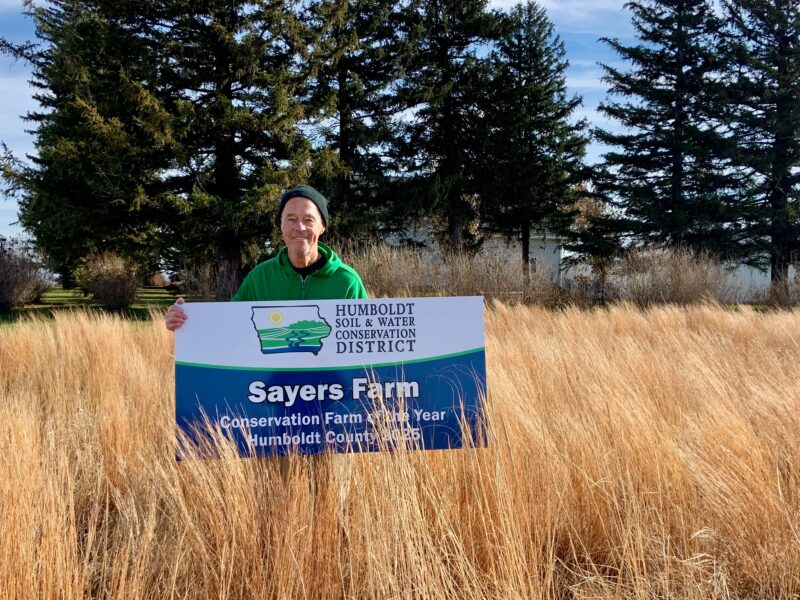
It was our honor to be named 2025 conservation farm of the year by the Humboldt County, Iowa, Soil and Water Conservation District, SWCD. This award typically recognizes full-time ag enterprises and operators who have made significant efforts to promote conservation knowledge and practices to protect natural resources, including soil, water, and air.
As a small, part-time farmer, I have tried things on a small scale that may be more difficult for others operating more acres than I do. And, because of my past full-time job in town (and now retirement), I have not been dependent on farm income for our family’s entire livelihood—giving me the flexibility to experiment, even if things do not always go as well as expected.
My conservation philosophy includes three principles:
1) Try new things
2) Make connections (with information, people, knowledge, and resources) and
3) Keep learning!
My Farm Background
It is my privilege to live today on the same family farm my grandfather bought in Beaver Township, southeast of Humboldt, well over 100 years ago. I live in the house I grew up in. I still find things in the machine shed my dad hung up many years ago. Sometimes I think he must have known I would need that part or hose or valve in the future, many years after he put it there!
While I was growing up on our dairy-poultry-swine-corn-hay-soybean farm in the 1950s-60s, we tilled everything, multiple times—including moldboard plowing all the cornstalks and soybean stubble every fall. Spring brought more tillage—including discing and field cultivating (sometimes twice with Treflan herbicide that required two incorporations for maximum effectiveness).
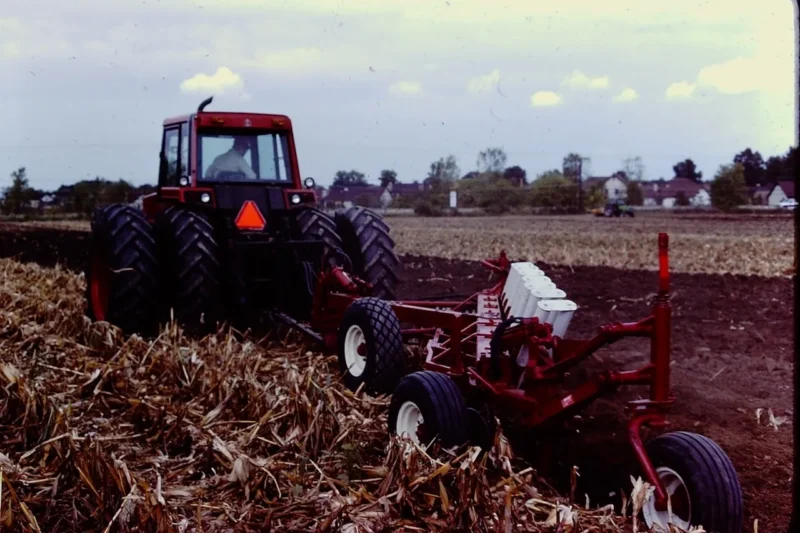
Conservation was an afterthought, if even that.
And walking beans. In the days before the invention and widespread adoption of soybean herbicides, we, like many other farm families, walked beans: hard, manual labor, especially in weedy places. Sharp corn knives and hoes. Pulling weeds until your hands turned green. My mom liked to call walking beans great family time together outdoors. My sister, brother, and I called it inhuman hot summertime torture, with forced parental conversation.
Then soybean herbicides came along, first replacing bean-walking with bean-riding (manually shooting weeds with herbicides), and eventually replacing mechanical cultivation altogether.
We cultivated everything back then, once or twice every summer—additional tillage through the field. I don’t remember exactly when I stopped cultivating to rely totally on herbicide weed control, only that I hauled our old cultivators into Humboldt to Hundertmark’s auction not too many years ago (after they had been sitting idle in the shed for many years).
Our farm’s first practice I could call “conservation,” was when my dad bought a chisel plow in the early 1970s. It had fixed shanks on a solid frame. But we still chopped the corn stalks and sometimes even disced ahead of that. Chisel plowing, which we called “reduced tillage” in those days, continued for many years with a few equipment upgrades. I kept the moldboard plow in the shed “just in case.” (However, that, too, later went to the auction in town.)
My conservation journey
My conservation story didn’t include much until recent years.
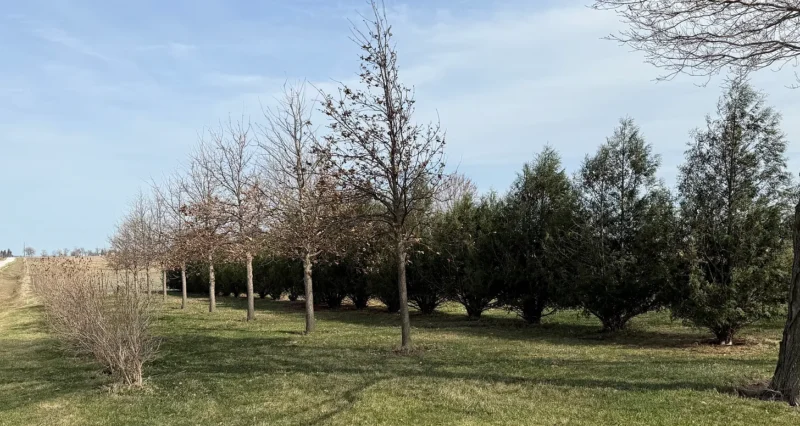
In 1998, shortly after my wife, kids, and I moved to the home farm, and my parents moved to town, we got advice and cost-share assistance through the USDA’s Natural Resources Conservation Service, NRCS, to plant a nice windbreak along the north side of our acreage. The deer chewed on the tender new plants the first couple of winters, but the trees grew back and are tall and healthy (and blocking wind) today.
I tried no-till planting soybeans into standing corn stalks for the first time in spring 2016. I had read about a few local farmers doing no-till to save on tillage costs and reduce soil erosion. I worried: Can my old Kinze planter even get the seeds into the ground through all that residue? Will the seeds grow? Will the old corn stalks plug up the combine in the fall? And, will there be significant yield drag? None of those bad things happened, and I have no-tilled beans into corn stalks ever since.
So, I had the courage to try (and learn) more things.
SWCD and More Conservation Involvement
As I gained more curiosity about soil and water-saving practices, I discovered that the USDA NRCS office in Humboldt was a knowledge and information source for all things conservation: technology, planning, info about practices, cost-share opportunities, and resources provided by committed, smart people.
Doug Adams, then NRCS soil conservation technician, asked about my interest in running for the Humboldt County Soil and Water Conservation District board. I learned SWCD commissioners are “volunteer elected local officials who govern districts, focusing on protecting, maintaining, and improving land and water resources through conservation plans, financial incentives for farmers and landowners, and educational outreach” (official description).
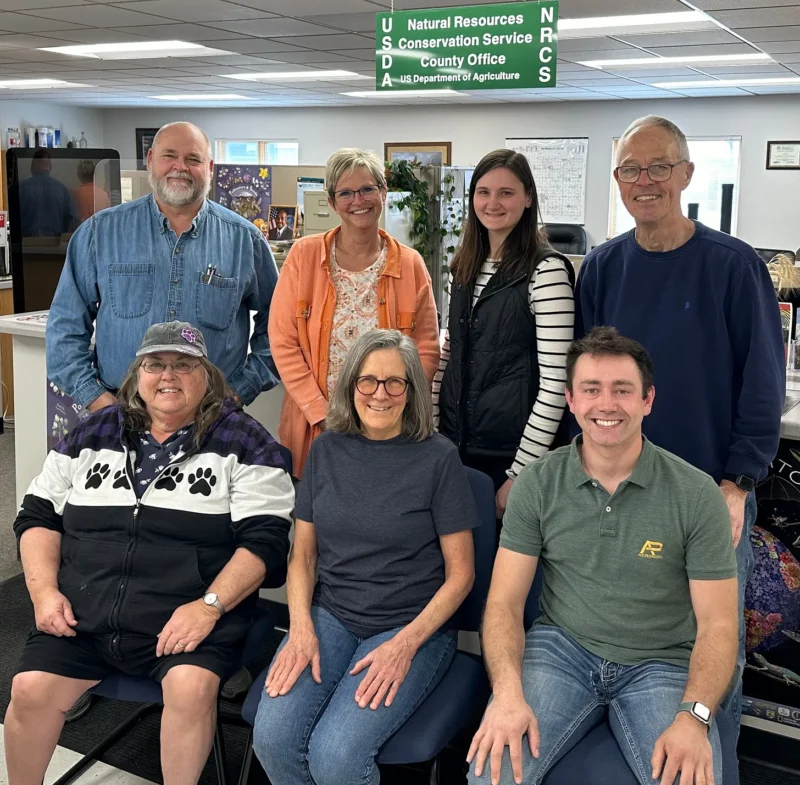
The SWCD is probably one of the lesser-known, non-partisan elected boards in the county. I ran in fall of 2018, was elected, and began service as a SWCD commissioner in 2019, soon to discover a new world of conservation activity, information, and involvement. The SWCD board continues to be one of my favorite groups of people who care about conservation, the community, and the environment. They are the best.
In the summer of 2019, I participated in the Iowa State University Master Conservationist program run by Humboldt County ISU Extension and Outreach, along with neighboring counties. This intensive early summer program connected me with people, resources, and conservation projects in the area.
More Conservation Practices
In the fall of 2019, I figured, “Why not try cover crops?” After seeing stories shared by Practical Farmers of Iowa, hearing about the experiences of local Humboldt County conservation farmers, and learning about incentives to help cover the costs of planting cover crops, it seemed like a good time to go ahead. Cover crops have significant benefits. My cover crops experience was both exciting and terrifying. I was still relying on my old, non-GPS planter. What if the cover crops did not grow? Or, what if they grew too tall? What if I had a problem terminating them the following spring? Well, all these things have happened to me since then.
My goal was to save costs of tillage and initiate long-term benefits—reduce soil loss, keep nutrients in the ground, have better weed control, and improve soil health and water quality—all documented through research from experts like the Iowa Soybean Association (ISA), Practical Farmers of Iowa, ISU Extension, and others. According to ISA, over the last few years, Iowa fields with cover crops have had average tile nitrate concentrations 28 percent lower compared to fields without cover crops.
For me, each cover crop year has been an adventure and learning experience.
Water and Potholes
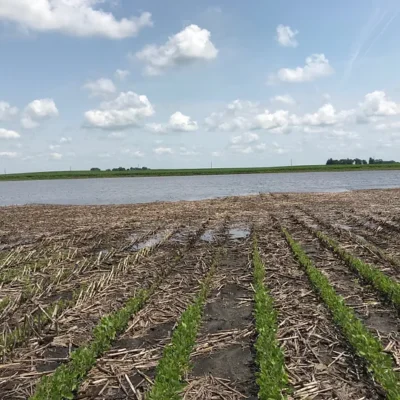
A long-time issue on our farm has been potholes and poor drainage. We are on the lower end of our drainage area’s tile line—meaning every time we get huge rains, my fields fill up quickly and are the last to drain. Some years, I have seen water spouting up my field intakes as pressure from fields above me forced water through county tiles into mine. And the neighbors’ fields always drained before ours did.
I could count on some of my spring planting being drowned out, one in every three to four years, leading to replanting; and getting drowned out too late in the season to replant about one in every five to six years—leaving a weed patch the rest of the season.
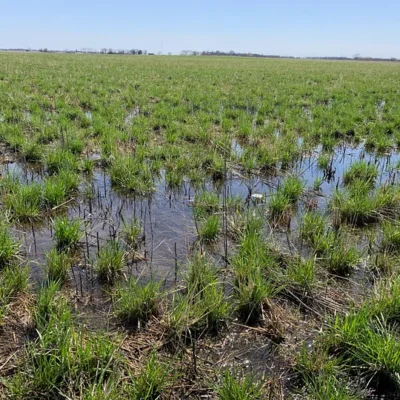
So, in the fall of 2020, with technical, engineering, and mapping help from experts at NRCS, I put a significant part of a field into a wetland—officially called by USDA, “Conservation Program 27 Farmable Wetlands.” Two intakes were excavated, the land was seeded with an NRCS-prescribed mixture of perennial plants, and I signed up for a Conservation Reserve Program (CRP) contract.
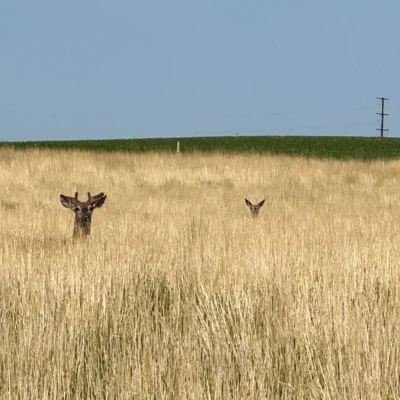
Benefits of wetlands include improved water quality through nutrient removal, flood mitigation (floodwater storage), and wildlife habitat. It has been fun watching this wetland change every year, all year, visited by pheasants and deer. It is no longer a pothole to plant and replant.
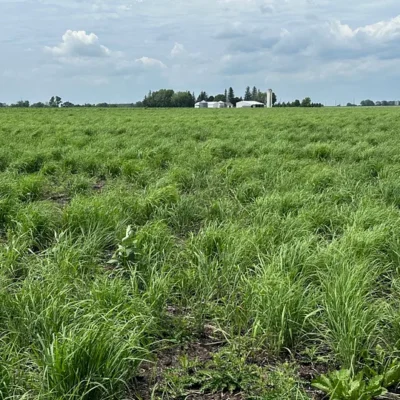
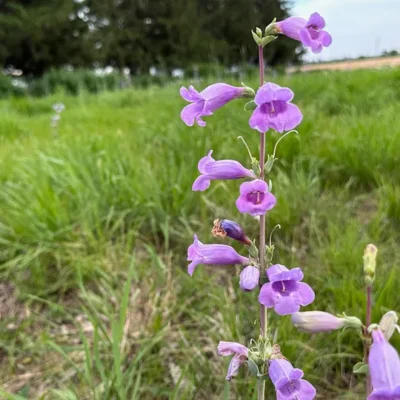
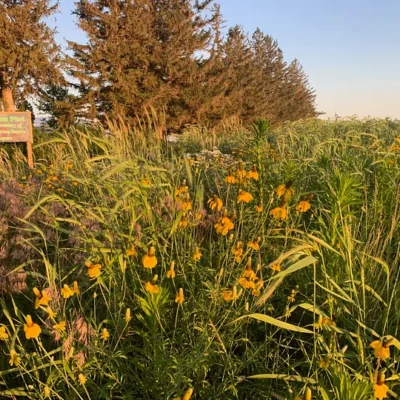
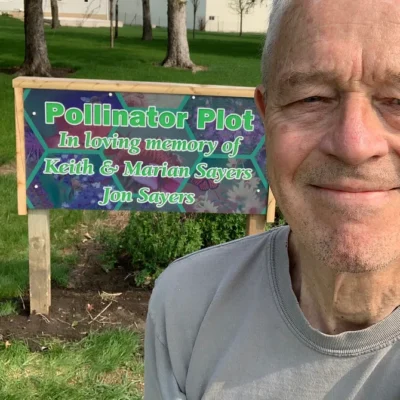
Also, during the fall of 2020, we planted one plus acre of “Conservation Program 42 Pollinator Habitat” just west of our acreage, in honor of my late parents and brother Jon “Zeke” Sayers. As we recognize the value of pollinators (bees, butterflies, and other insects) to our food supply, this spot provides a place of peace and refuge, not only to pollinators, but to our family as well.
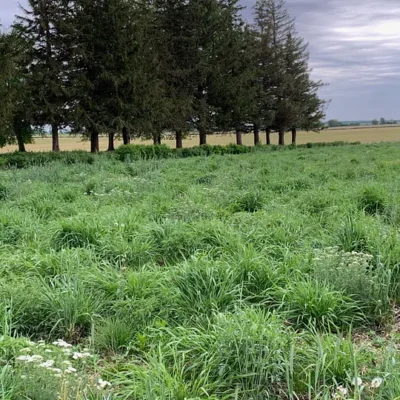
Finally, just last fall, a new “Conservation Program 43 Prairie Strips” area was seeded along the southeast field edges of our farm. The NRCS seeding plan included about 35 perennial grasses and legumes. This is some less well-drained farmland and will promote conservation as a wildlife sanctuary.
Resources and Connections
The best thing about my conservation journey is that it has included information, people, knowledge, and resources.
The ISU landowner conservation program, initiated in the summer of 2024, is intended for landowners interested in learning about soil health and conservation. I loved that experience. In my evaluation of the program, I wrote, “After every session, I came home energized and excited by what I learned, the great people in my cohort group, and the new conservation connections I made. So many great resources, experts, and sources of conservation info to help landowners like me! It was an outstanding program that will help me make wise(r) conservation decisions in the future.” Applications are now open to join this program this summer (2026, with an application deadline of April 10).
In addition to NRCS and ISU Extension, at the top of my conservation knowledge list are:
Practical Farmers of Iowa, PFI An inclusive organization representing a diversity of farmers, with a mission to equip farmers to build resilient farms and communities. PFI was 40 years old in 2025.
Iowa Learning Farms Established in 2004, Iowa Learning Farms is building a culture of conservation by encouraging the adoption of conservation practices. Through field days and workshops held across the state, as well as virtual offerings of field days and weekly webinars, Iowa Learning Farms strives to offer access to current conservation, water quality, and soil health information.
Climate Land Leaders, CLL CLL’s mission is to provide community and support for land stewards creating climate resiliency. I enjoy connecting with other landowners across the Midwest who are interested in their farm legacy and conservation.
Iowa Agriculture Water Alliance Lists various conservation cost-share programs.
The Future
At my age and following a heart-related issue one year ago, I depend on key people to support our farm. My great neighbor just over the fence south of me, Chris Kirchhoff, plants, combines, and always pays attention to my fields. Joe Bohan, local NEW Cooperative agronomist, continues to provide fertilizer and herbicide recommendations and service.
When my CRP needs mowing, I do that myself.
If my capability and interest in learning and trying new things continue, and my ideas and input are still of value, my conservation journey can keep going.