
Dr. Katie Ross is an independent writer and researcher, with a background in ecology, renewable energy, regenerative agriculture, transdisciplinary research, and transformative sustainability learning. Knowing how stories hold, transmit and transform paradigms, Katie is keen to share these stories of regeneration.
Out on the Landscapes – Dr. Katie Ross
Nature has developed brilliant ways of cooling our landscapes and balancing our climates in the face of the Sun’s powerful, relentless energy.
In recognition of this living perspective of climate, Climate Land Leaders hosted a second Nature Cools project this summer (read about our 2025 trial here).
The purposes of this project are to share the story of how Nature balances energy and climate (hint: the movement of water through life is key), and to – together – do several soil and landscape observations that demonstrate the principles of how Nature Cools, as well as deepen the relationship between Climate Land Leaders and their soils.
To learn more about what we did and why, read our first blog, How Nature Cools.
And, below, I share the story of what we observed across four Climate Land Leader properties in Illinois and Wisconsin, as we traipsed to silvopastures, naturalised tree plantations, grazing pastures, conventional cropping, restored prairies, and woodland areas to watch their varying responses to water infiltration and the weather of the day.
Story synopsis: with our four Climate Land Leaders in this 2026 Nature Cools project, we saw:
- The cooling power of forests, woodlands, tree breaks, diverse vegetation cover, and diverse living soils, all which help hold and move water through the living system.
- Much faster water infiltration in areas with living diversity above and below ground.
- Areas undergoing restoration showing signs of more soil organisms and fungal hyphae, darker soils, more soil structure, more organic smells, deeper and thicker roots, less compaction.
Short on time? Listen to this Public News Service piece about our Nature Cools project!
You can also check out Climate Land Leader Leslie’s compelling story of our visit.
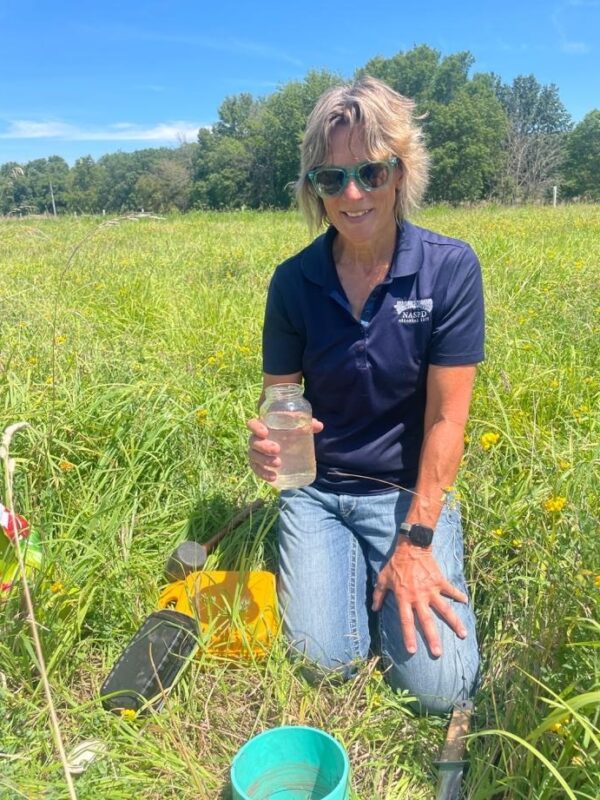
Getting our hands and noses in the soil
It is the end of July, and the corn is well past knee high.
On this crystal-clear, blue-sky day, just outside Potomac, Illinois, a group of four women walk towards our first site of our ‘Nature Cools’ observations for the day.
We are on the farm of Climate Land Leader, Betty Brennan, in one of the pastures that she stewards for her flock of 50 sheep.
For the past two years, Betty has sown this pasture with a grazing plant mix, including orchard grass, smooth bromegrass, tall fescue, white clover, and birdsfoot trefoil.
Prior to Betty’s stewardship, this pasture had likely been tiled and drained by industrious settlers, rotated between corn and soybeans, and sprayed with pesticides as they became the practice du jour. In other words, the soil health, composition and structure have been significantly altered over numerous past decades.
It is about 1 in the afternoon, and the prolific sun is high in the sky. We all feel our sweat gathering like headwaters and dripping under our shirts.
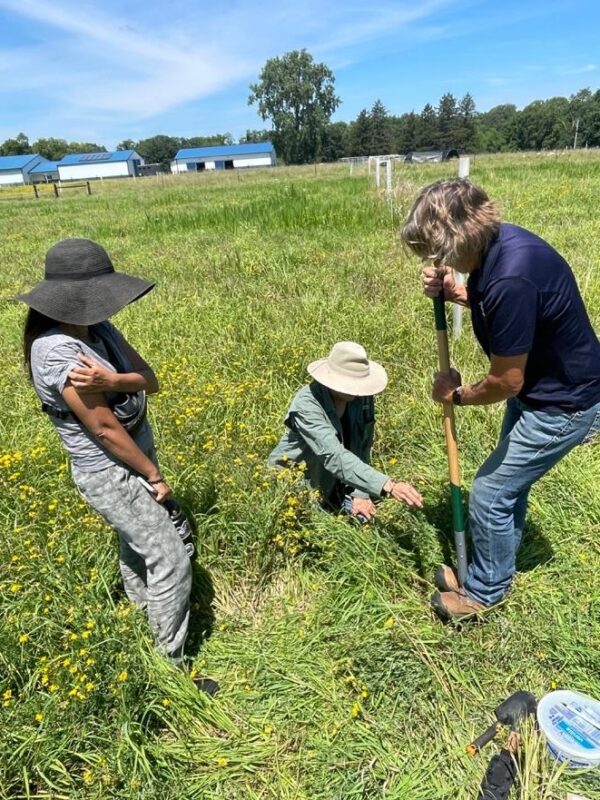
The four of us – Betty the owner of Bluestem Springs Farm, her botanist friend Connie, Rozina from Climate Land Leaders, and me – walk to the middle of the sheep’s pasture to begin our soil and landscape observations, each of which illustrate aspects of Nature’s cooling processes.
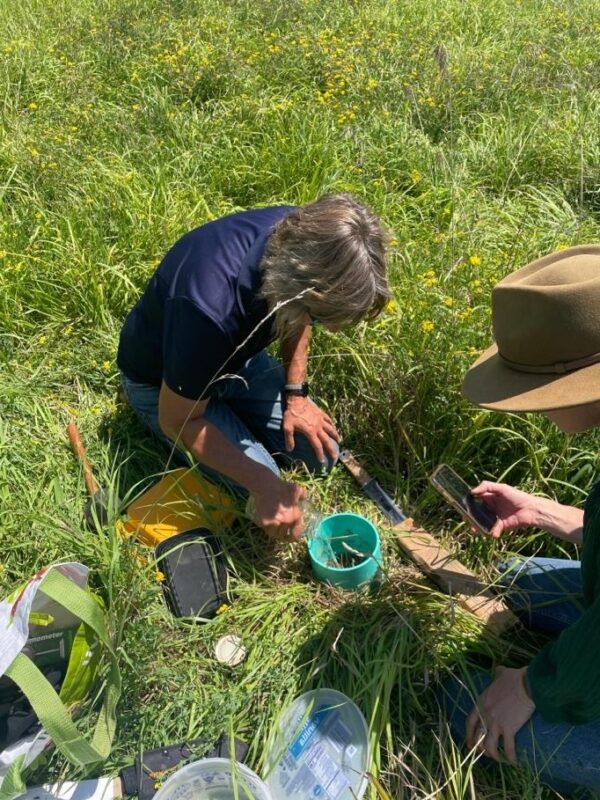
We start with a relatively straightforward observation of timed water infiltration. Before traveling to Illinois, I used a reciprocating saw and vice grips to cut a 6-inch diameter PVC pipe into a 7-inch-long section.
I then traced matching lines on the inside and outside of the blue PVC pipe with a black Sharpie, demarcating a depth of 3 inches and sanded a sharp bevelled edge on the bottom of the pipe – at inch 0 – allowing for an easier-ish time of pushing the tube three inches into the soil.
Along with the tube and a mallet, Connie carried our one-gallon ice-cream tub filled with water. At each site, after we place a wooden board over the top of the PVC tube and mallet the pipe into the ground – trying our absolute best to keep the tube level as we pound it in – we pour the equivalent of 1 inch of ‘rain’ into the tube, and time how long it takes for the water to infiltrate and disappear into the soil.
We pour this 1-inch equivalent of rain (or 450 ml which is also measured out by Sharpie on a glass jar we carry with), into the PVC tube two times, so that we can compare how long it takes for rain to percolate in both ‘dry’ and ‘wet’ soil conditions, and to see how well the soil structure withstands a bit of water.
Does it melt like cotton candy and collapse in on itself, or is it a sponge that water can percolate through?
At Betty’s first site, we pick a random yet indicative spot in the middle of the sheep paddock; meaning it seems representative of the average ground cover, slope, etc. Of course, we could drop a pin on our iPhones to mark the location for future reference, but instead, we pick a spot that can be found using an old-fashioned analogue approach: “on the line between paddock 4 and 6, halfway between trees 2 and 3, as you count them from the south” I write on the observation sheet.
I use a hori hori knife to clear some of the grass and begin the process of pushing in the PVC pipe. It is not a quick entry. Even with a bit of initial cutting along the PVC outline using the knife, and taking turns with the mallet, we can only budge the PVC pipe one inch into the ground.
We are putting in more effort than the previous day when I visited Climate Land Leaders near Broadlands, Illinois, Erica and Leon Peters. Their property is quite different in that they own land that has likely never been tilled nor tiled. Their topsoils are still a thick charcoal black, and in a black walnut grove planted by previous owners over 70 years ago – and which has naturalised over time – the PVC pipe enters smoothly; relatively speaking, more akin to a hot knife through butter.
“Well,” I say, more sweat gathering on my brow, “for the purposes of today, this depth of the PVC at one inch in the soil will work. These observations are not seeking statistical significance and precision per se, but are more about developing a relationship with your soils, by getting out to see them in different seasons each year and starting to see trends, like how easy it is to insert a shovel or spade, or mallet a PVC pipe into the ground.”
Betty does the honours of pouring in the first 450ml, and I hit start on my iPhone stopwatch.
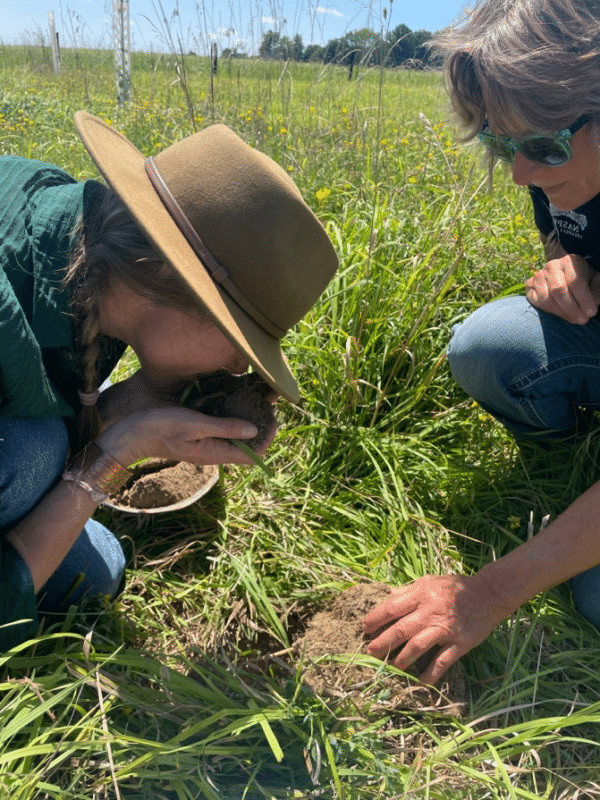
Soil with little biological life – or rather dirt – has little smell. Conversely, a clean, fresh, earthy, sweet scent can indicate that healthy bacteria and fungi are breaking down organic matter. And this organic matter is very important.
More organic matter means more water storage below ground. As a very rough rule of thumb, according to the USDA Natural Resources Conservation Service, each 1% increase in soil organic matter allows the top six inches of soil to hold an additional 20,000 to 27,000 gallons of water per acre!
That’s a whole lot of water to keep soils moist during periods of less rain, to moderate fire intensity, and to keep a diverse soil community of bacteria, fungi, protozoa, nematodes, arthropods, and worms hydrated.
And, this diverse soil ecology supports healthy, more resilient plants and animal life above ground, which helps Nature Cool.
– – –
We wait in the direct sun for this first pour, for what feels like a while, looking through the soil for insects, worms, thin little white filaments, which can mean a fungal presence, but find very few moving, crawling or wriggling soil organisms.
In addition to soil smell, we explored soil color, structure, nodulation, root depth, and rhizosheath coverage – all of which can indicate the health and function of soil.
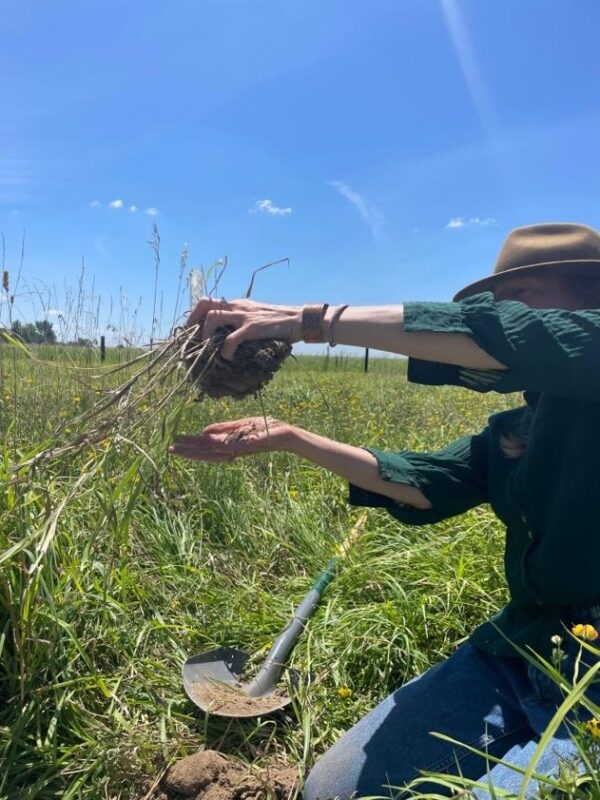
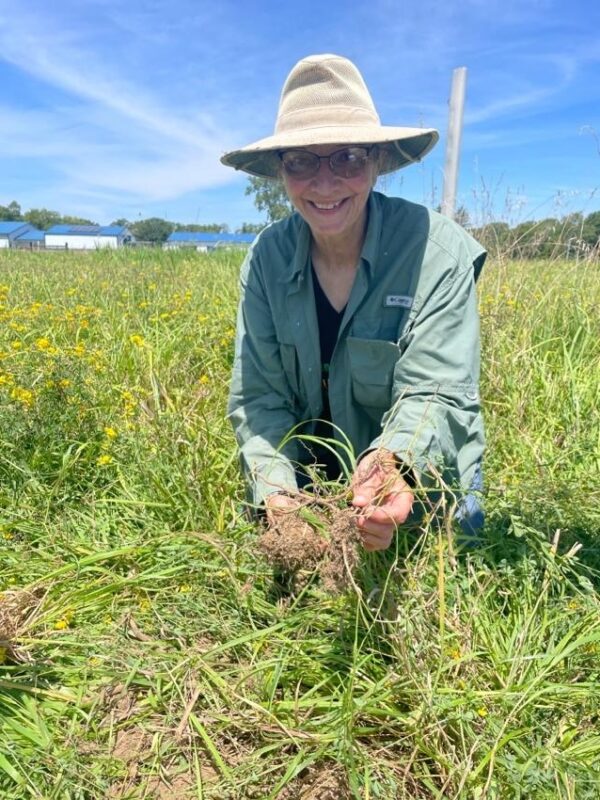
Our botanist Connie points out a birdsfoot trefoil, a member of the pea family, and we follow its roots down to find some nodulation, indicating potential existence of a symbiotic nitrogen fixating Rhizobium root bacteria.
The soil in this sheep’s pasture was tan, perhaps due to the loss of topsoil and diverse soil community over the years of tilling, bare ground and spraying. Most roots stopped at a depth of about 3 inches, potentially because of the soils’ compaction from the last several decades of management practices.
Slow infiltration in compacted soils
Back in Betty’s sheep paddock, I glance at my phone to see how long the first pour has been infiltrating just in time before my phone turns itself off, with a warning that it is overheating. Rozina quickly starts her stopwatch, so we can add our two times together, and I put my phone in the shade of my body.
It’s hot. The air thermometer reads 88 degrees F, yet, the ground surface in the shade of the plants is 6 degrees cooler (82 F). “So, this is how it feels to be an animal in the field on a hot sunny day,” Rozina comments.
The last of the water trickles underground from the first pour, and just in time my phone turns back on. 18 minutes and 52 seconds for the first inch of water.
We pour in the second 450ml and start the timer again. This second pour takes 15 minutes for a half an inch, so we stop the timer and extrapolate that it would be about a half an hour for a full inch. Again, these observations are not about precise timing, but rather ‘practical science’ comparisons and trends over time.
The infiltration rates we see in Betty’s sheep paddock are similar to sites across the four properties we visited this summer which also have a history of soil disturbance, e.g. tilling, spraying, oxidation, erosion, etc.
Similar to Betty’s sheep pasture, these soils were hard to mallet the PVC pipe in 3 inches.
In areas with a long history of conventional cropping – even if they are in their first year or two of regeneration – infiltration of 1 inch of water ranged from 7 – 23 minutes; and the second pours took an estimated 30+ minutes or longer (Figure 1). Also, notice in the photos, the light colour of these soils, and little soil aggregation, or clumping.
Just to reiterate, Figure 1 is not about comparing each farm with each other (as each farm has a unique soil type and even unique moisture levels on the day). Rather the comparison is between what sites were slower (Figure 1) and what sites were faster (Figure 2) on each farm’s unique landscape for the particular day we were at each farm.
In sites with a long history of conventional cropping – even if in the sites are in their first year or two of regeneration – infiltration rates were mostly longer than 10 minutes (Figure 1). In sites with more diversity for longer time periods, infiltration rates were mostly shorter than 10 minutes.
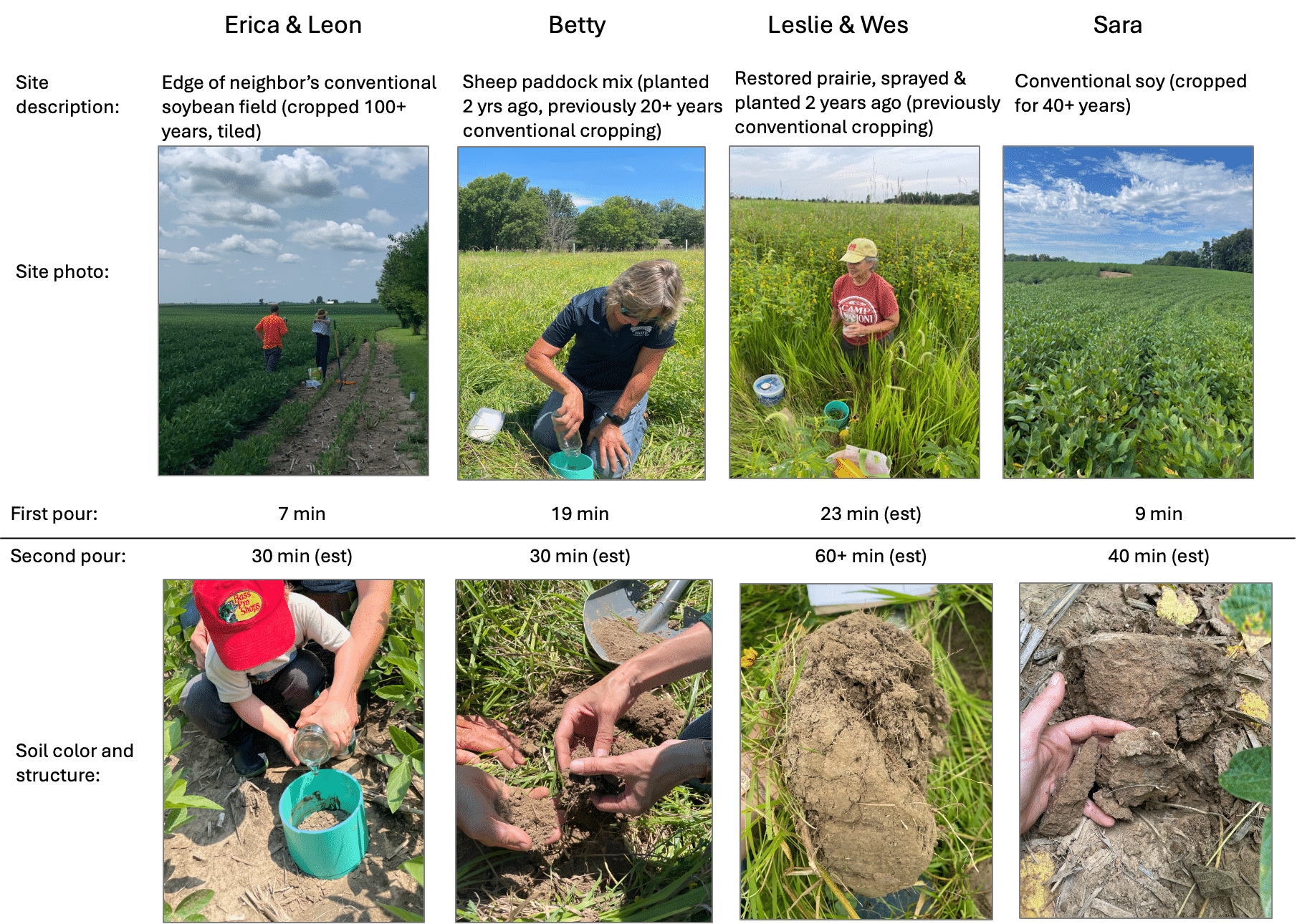
With little soil ecosystems and soil aggregation, soils struggle to absorb and store water.
Related to this, Leon told me a fascinating story while visiting their property.
As I mentioned above, their 5 acres have never been tilled nor tiled, and have the darkest soils across the four farms. Erica and Leon have lived on their 5-acre property, which they lovingly refer to as The Island, for about six years, purchasing the land after falling in love with the house. They took over care-taking the previous owner’s orchards and herd of a Eurasian fallow deer.
Last year, there was a drought across their Champaign county. Two of their neighbors’ wells went dry from Spring to Fall, meaning they had to bring water in. Erica and Leon mention how their well went dry too, after accidentally leaving on the hose, but after 3 days the water came back. They wondered if this is because they do not have tiles on their property.
I also wonder if a contributing factor is how quickly water can infiltrate into their chocolate-cake soils, especially when surrounded by tile – meaning how much extra water do they receive across the five acres and how much can this absorb? An important question for a hydrologist.
Diversity creating a water-loving soil sponge
At Betty’s, we gather the shovel, mallet, thermometers, bottle, bucket, knife, pens, phones, and make our way to her second site, via her kitchen to rehydrate ourselves.
I am quite keen to visit this second site at Bluestem Springs Farm, as Betty had planted this namesake prairie grass in the field over 20 years ago. Beforehand, this field had been under annual row cropping rotation (corn and soybeans).
When we arrive at the regenerated Bluestem prairie, we sit down to push in the PVC pipe. The soil compaction was far less, and it was indeed easier to insert. The first pour took 52 seconds to infiltrate, and the second pour was 3 and half minutes! Betty was blown away to see the difference that these perennial plants, plus 20 years, can make in terms of the landscapes’ ability to effectively harvest rain.
Looking across the four properties that we visited for the Nature Cools project, infiltration was similarly quicker in more naturalised areas, or areas under regeneration for many years, with the first pour infiltrating between 1 – 3 minutes in the Peters’ naturalised black walnut grove, Betty’s restored bluestem prairie, Leslie’s woodland (near an ancient oak), as well as Sara’s restored prairie and woodland (Figure 2). The 2nd pours took longer, ranging from 3 – 14 minutes.
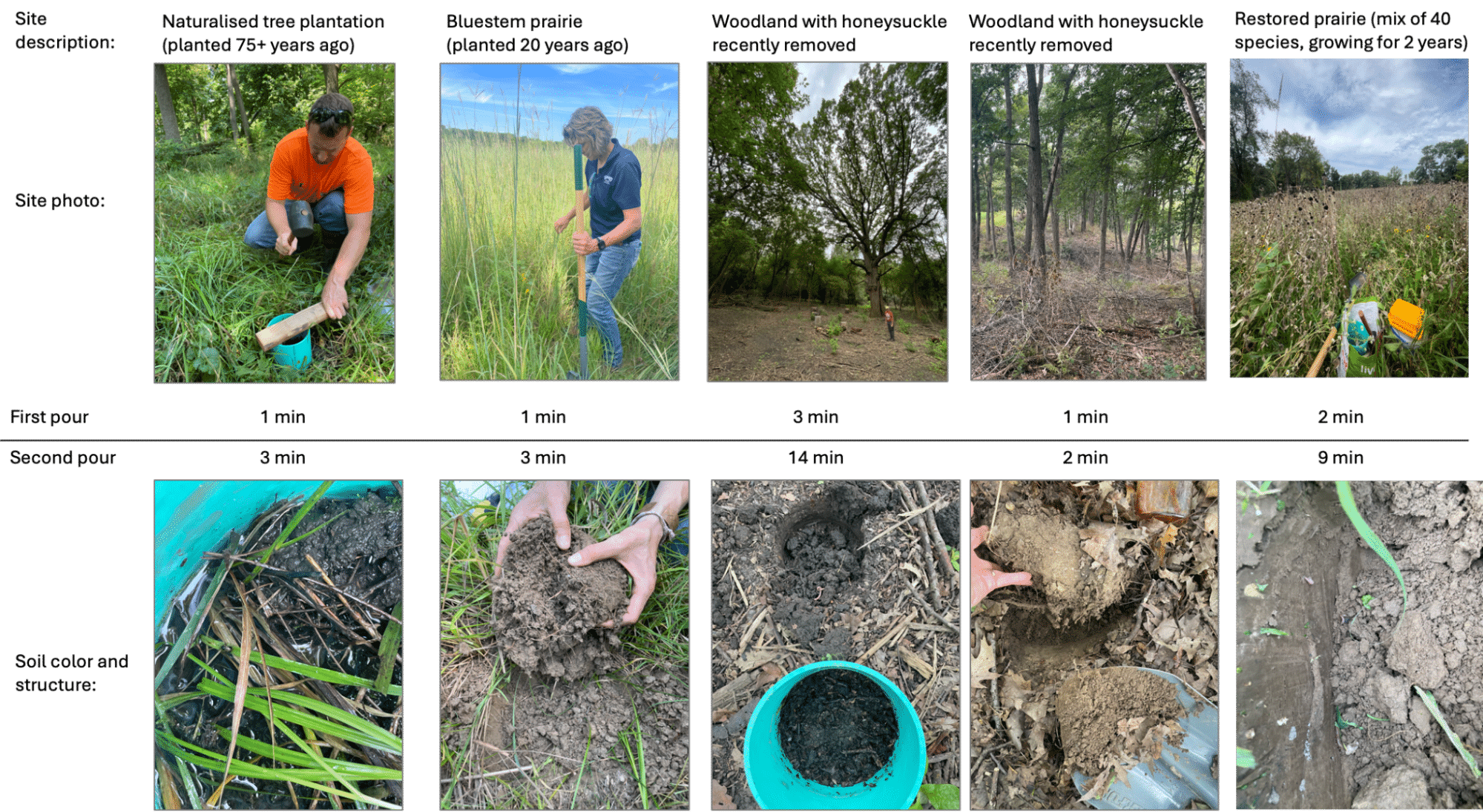
Presumably, microbial and plant diversity at work in more naturalized areas, creating a water loving, soil sponge.
Longer 2nd pours could reflect less stable soil aggregates.
The cooling power of forests
Along the way to Betty’s second site, we paused at the edge of a near-by forested area. With the shade, and the natural air-conditioning that happens as plants transpire, the air was 6 degrees (F) cooler and the ground was 4 degrees cooler, compared to the sheep paddock (Figure 3). Sweet relief.
At our second site on Betty’s farm, we found an even greater difference in temperature between the sun-soaked areas of the prairie and the forest. The air in the older forest was 13 degrees cooler than in the field. Even sweeter relief.
We undertake the Nature Cools visits during the heat of summer, hoping for full sun to be able to show how different parts of the landscape respond to the Sun’s energy. Out of the four visits, we only had two that were on completely blue-sky days.
But, comparing temperatures of open pastures to forested and woodland areas on these two sunny July days in Central Illinois, we saw similar patterns of cooling from forests at the Peters’ and Betty’s (Figure 3).
The Peters’ naturalised tree plantation was over 10 degrees cooler, both in the air and at the ground surface compared to their grazing pasture, and below ground was 2 degrees cooler.
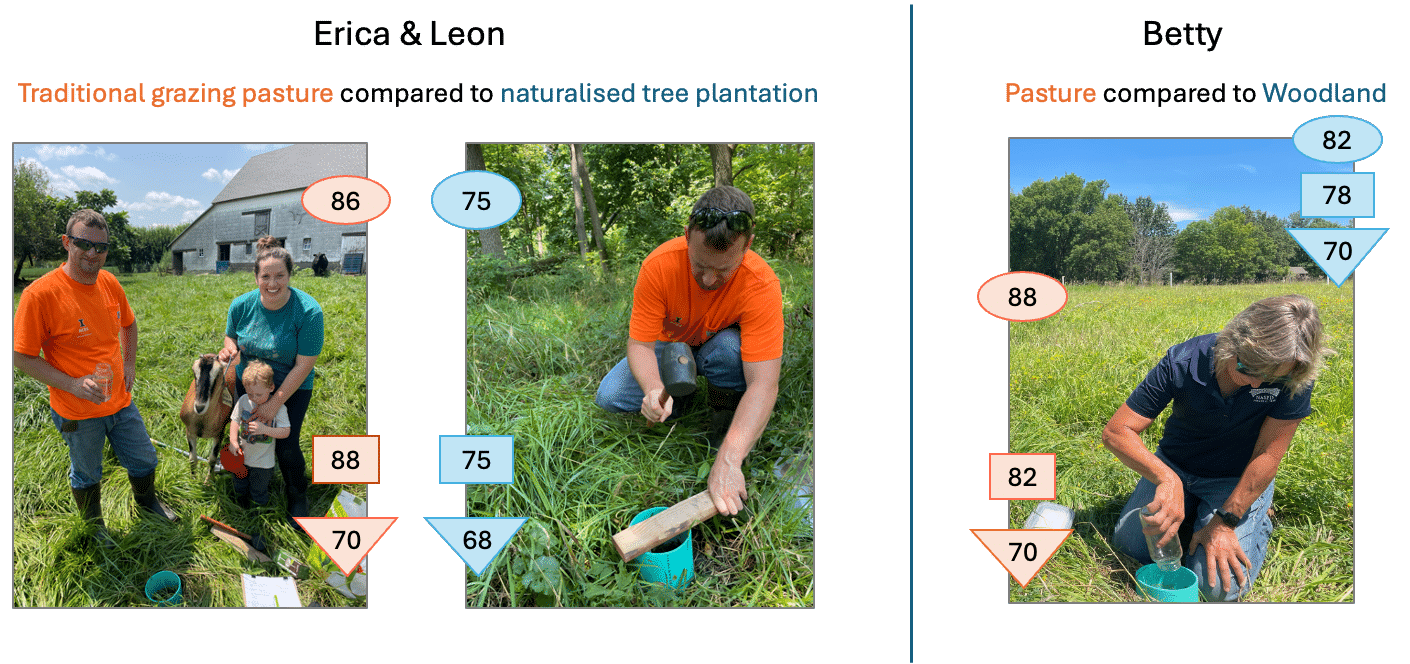
Diverse forests can be powerhouse air and climate conditioners.
Leslie, who also participated in the Nature Cools project, shared similar cooling processes in the microclimates of her farm in her Substack article written last year, with even more profound temperature differences in a heat wave.
Shade of any plants and tree breaks can also be relatively cooling
At Betty’s second site, we once again find another spot indicative of the prairie field, but this time, for the purposes of our own comfort, we find a place also within the shade of the tree break.
As we all know from our lived experience, shade, at any level, makes a noticeable difference in temperature on a sunny day.
And this was no different. Comparing where we chose to sit in the shade of a neighbouring tree break and another site in full sun six feet away – there was an 8 degree difference in air temperature and 7 degree difference in ground surface temperature (Figure 4). Blessed shade!
In fact, the hottest site we encountered this summer was a bare edge of a soybean field on a sunny day. The air temperature above the bare ground was 90 degrees, the soil surface was 114 degrees, and soil below ground was 75 degrees (Figure 4)!
However, just three rows over, where the soil was covered with soybeans, the ground surface was 26 degrees cooler (88 F) and below ground was five degrees cooler (70 F) (Figure 4). Shade, at any level, matters!
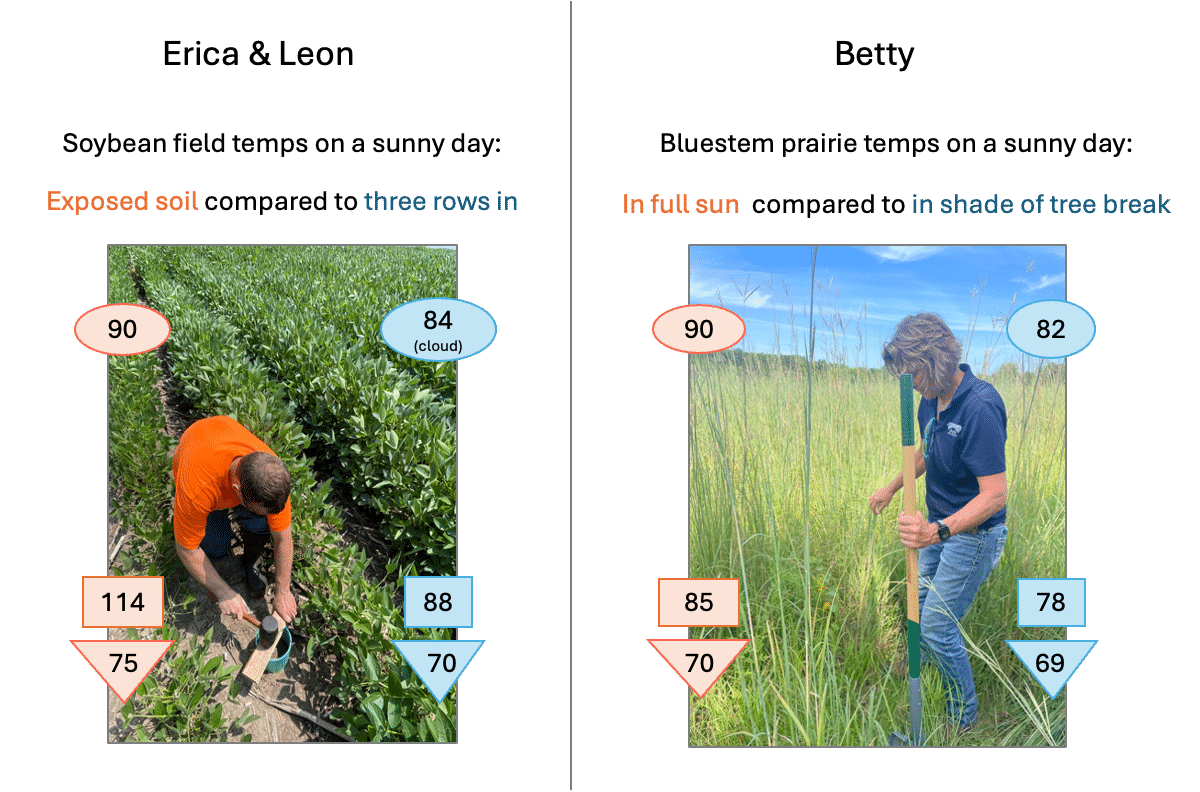
Shade of any type of plant is better than bare ground. And every bit of increasing canopy height diversity (re: plant diversity) helps with cooling.
Diversity cools
At Betty’s second site, we also saw more soil pores, made by soil organisms. And perhaps even more excitingly, when digging through a shove-full, we found several worms.
Using a white piece of paper in a plastic container as a background, Betty snapped a photo and ID’d it as a native ground worm. We all clucked like proud mother hens, flush with joy for seeing native worms. We gently put the worms back, thanked them for all they do, and restored the soil as best we could, from where it had come.
Comparing observations of temperature across fields, with different levels of plant diversity, in full sun raised an interesting question.
As compiled in Figure 5, fields with greater diversity in plant families and canopy structure in full sun had:
- more cooling between air and surface temperatures,
- cooler surface temperatures, and
- less temperature difference between the soil surface and below ground.
Now, these practical observations are not a statistical study and there are so many factors at play including that these temperatures were taken on three different days and different times of day. Rather, lining up the sites from lower diversity towards greater diversity and comparing how each site responded during a moment of hot sun, merely illustrates the principle that keeping ground covered with plants can reduce heat, and greater plant diversity, canopy structure and thus microbial and soil food web diversity, can facilitate more cooling.
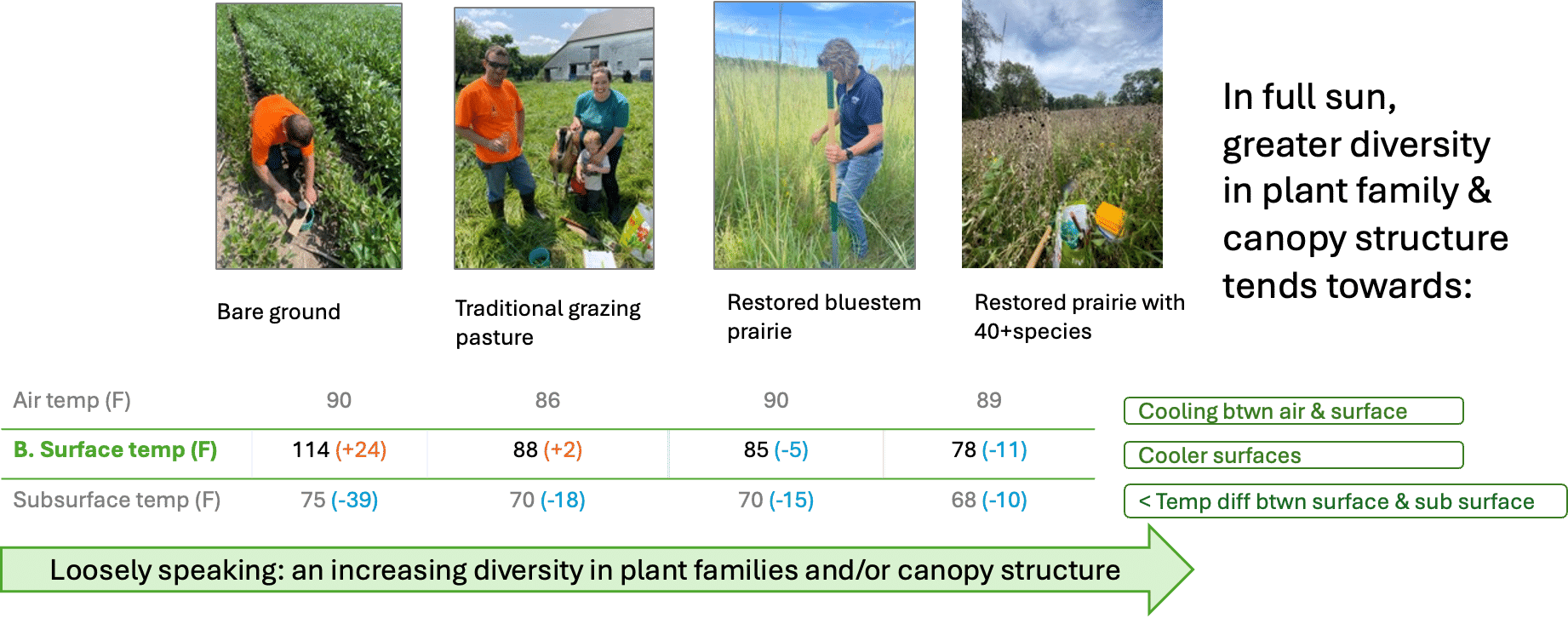
Diversity above and below ground works together to cool.
Water in the landscape creates cooling
During my last Nature Cools visit this August to Sara Hatleli in Wisconsin, the Climate Land Leader who hosted me (as Sara was traveling conducting freshwater samples) wondered about the temperatures in forested areas with honeysuckle removed versus areas with honeysuckle.
Honeysuckle is a challenge to native diversity in woodland and forested areas in the Midwest, and many conservation-minded land stewards are working to restore more diversified landscapes. Leslie and Wes – both soil scientists who participated in Nature Cools – share their story of removing an incredible volume of honeysuckle, in order to help steward in more diversity (which is important, as we saw above).
Curiosity piqued by this question, I traipsed off to both types of areas. On this particular cloudy, hot, humid day, the comparison at Sara’s showed that the woodland with the honeysuckle was cooler than the woodland without honeysuckle; but both were cooler than the soybean field (Figure 6).
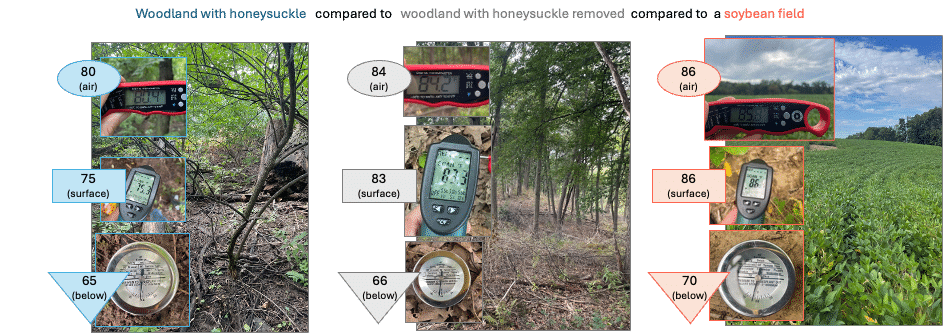
More water in a living soil and landscape helps keep the temperatures cool.
Diversity above and below ground works together to cool.
While denser forests can have cooler temperatures, as the vast majority of the sun is blocked, and more moisture remains in the system, obviously there are many other considerations for managing invasives such as honeysuckle.
How to build back the soil engine and soil sponge?
In sum, a big part of helping Nature to cool again is landscape and waterscape restoration.
And a big part of this is soil health restoration, as we saw above (Figures 1, 2, 4, 5).
While visiting with Climate Land Leaders this summer, I heard several stories of degraded landscapes being planted with trees as part of the restoration efforts, but the tree plantings had low survival rates.
While many factors could contribute to this outcome, one perspective that comes to mind is something an agroecologist I worked with at Soils for Life, Sarah Fea, told me:
The productivity of the land above can only match the diversity of the land below. If the ‘below-ground herd’ (Sarah’s name for the soil microbial community) is operating with the engine of a small scooter, we can’t grow or graze a Rolls-Royce.
In other words, if the soil structure has been degraded for the past 100 years, the microbial community and soil structure might not be able to support trees – and their cooling processes – right away.
But, with increased size, complexity, diversity of the below-ground herd, more complex, diverse plants become possible above ground.
In other words, in addition to native diversity, rewilding wetlands, and slowing the flow of water across landscapes, restoring the soil carbon sponge and microbial community is essential for restoring landscapes, local rain cycles, and regenerating Nature’s inherent cooling processes.
It is possible to build soil health. Some of the actions land stewards can take to speed up soil enlivenment include: increasing diverse perennial roots, adding organic matter (via crimping, compost, mulch, biochar, crimping), aeration, and observations of soil and plants relationships over time. Sources of inspiration abound, and here are a few:
Letting the microbial superstars do the work, simple steps to build soil biology. A conversation with Dr Mary Cole. 2025.
Basic dynamics of soil microbiomes, and practices and principles to inceas soil microbial health. An article with agroecologist, Sara Fea. 2023.
For the Love of Soil. A book by Nicole Masters, 2019.
– – –
Restoring the landscape and its myriads of relationships is such a profound act in our times. And, much of the success of our actions rests on our inclusive glance down to the soils we walk on.
Now, next summer, imagine if we have a Climate Land Leaders collective doing the NRCS Soil Your Undies Challenge together!
Or, if we could find and share the story of the presence of rain-producing fungi and bacteria on our landscapes…