Why have you restored prairie?
In the 1980s, it became apparent that no one was interested in continuing the family farm established in 1883 by our great-grandfather. Our mom considered farmland trusts to protect the land from development. Her focus shifted after joining a conservation effort to monitor devastatingly low Bald Eagle populations in Northwest Ohio, and during her work on that highly successful restoration project, she chose to protect the land through the USDA Farm Service Agency’s Conservation Reserve Program (CRP). The farm was transitioned in 1993 to a tallgrass prairie and became a sanctuary for native floral and fauna, attracting birders from around the world.
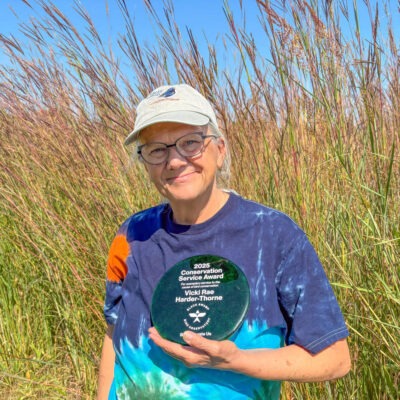
The family land, now known as Earth Heart Farms, is 80 acres on the Little Portage River in the Lake Erie Basin of The Great Black Swamp, land formerly stewarded by the Erie (Western Seneca) and the Anishinaabe Alliance (Odawa, Ojibwa and Potawatomi). The restoration of this grassland helps improve resource quality to remediate and protect Lake Erie from nutrient loading that has caused Harmful Algal Blooms (HABs). There is also public access (with permission) for research, education, and connection with the natural world.
What are you currently working on with prairie projects?
In 1993, it was common to plant warm season grasses for pollinator habitat. Three decades later, the practice changed to using 25% cool season grasses and 75% pollinators. Invasive and aggressive plant management is ongoing. The seed bed is inherently dense from decades of farming, and the 2023 excavation of the emergent wetlands really stirred things up. Our goal is to continue spot mowing and to rotate prescribed burns of 20 acres each year.
The nearly 3-year-old riparian buffer is showing signs of surviving three droughts. It’s time to take inventory of what is there and replace understory trees and shrubs needed for a balanced ecosystem.
We’ve attracted the attention of researchers who are studying the impact of water level on water quality in Lake Erie. A solar pump will be installed in Spring 2026 to help increase water levels in the wetlands. The success of this depends in part on rainfall and winds that affect pumpable water sources nearby. A wildlife biologist recently reminded me this is a young wetland that needs time to mature. For example, once muskrats establish more dens, the water will disperse, and water levels can balance out. [NOTE: see Patience below]
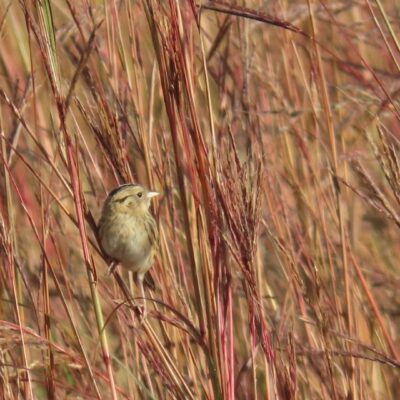
A BioBlitz was conducted in August 2022 as a baseline before the 2023 wetland extraction and revitalization of the grassland. A second BioBlitz is scheduled in August 2026, which will help us determine how the habitat changes have affected biodiversity.
What are your tips for success?
- Passion. I couldn’t do this without a core belief in the importance of land restoration. That, and a wish my grandfather shared with me when I was 10 – the observation that people took too much land for themselves, forgetting about all the other beings that depended on it, and if he could afford it, he’d give it all back. My mother started to do that in 1993, and I vow to continue growing it for the health and wellbeing of the fauna, flora, and funga that improve and protect our natural resources to provide life for all.
- Persistence. For me, passion drives persistence. The groundwork was laid by my grandfather’s wish and my mother’s commitment to honor it. There’s a lot to keep track of in stewarding land. Starting in August 2020, I kept a detailed journal, recording every lead, every conversation or email, and every possible advocate from regenerative agriculture, conservation, parks and educational programs – over 400 pages in the first 2 years! That effort is a lifeline – a wealth of dedicated collaborators with many decades of experience to contact when I feel overwhelmed by things such as invasive plant species management or defunded programs. I have also noted different pathways for the future because I started this in 2020 at age 65. The vision includes a Land Back initiative that might be best accomplished through a combined Conservation Easement in Perpetuity and a Cultural Use Easement.
- Patience. Like Nature, this process takes time. Like Nature, there are predictable cycles and there are unforeseen events. It’s sometimes difficult for me to stand back and allow the unfolding. And yet, that is sometimes exactly what is needed. We can construct emergent wetlands, plant 500 saplings per acre, and overseed the existing tallgrass prairie with a heavier mix of pollinators. We can utilize prescribed burns, spot mowing, and harvesting the blossoms of invasive biennials (I’m thinking of teasel here). Perhaps there’s a season or more of drought, which allows the growth of too many cattails or the death of a significant number of saplings. Perhaps your trusted habitat manager is furloughed, or a personal health issue takes precedence. Patience includes flexibility and deep trust that things will be ok.
- Peace. The passion that drives persistence, the patience that allows connection to something much bigger than the work itself, leads to a deeper sense of peace than I ever imagined possible. I watched my grandfather taste the soil so he knew what to plant the next farm season. He recognized Bald Eagles riding the wind currents when neighbors told him there were none in NW Ohio. He cried when the last 7 acres of woodland were harvested to make ends meet. He shared the importance of the land as provider for more than humans. 60 years ago, his wish was imprinted on my heart, and even when it feels like an exercise in futility – when I read statistics about habitat loss or watch another woodland cut for yet another development, I close my eyes, take a few deep breaths, and remember how fortunate I am to have this opportunity to improve our world. I see the face of my grandson, hear the thrumming of woodpeckers, smell the wet earth, feel the wind on my face, taste the nectar of red clover, and I know exactly why I keep going.
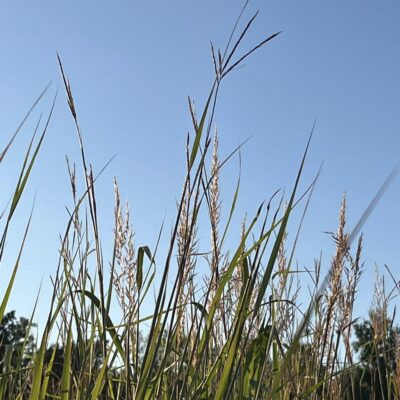
Big Bluestem
What do you wish you had known before you started restoring prairie? Mistakes you don’t want to make again?
Start-up mistakes aren’t entirely relevant for me, as I’m fortunate that the grassland had been established starting in 1993. It was after our mom’s death in 2020 that I chose to continue her legacy. I spent time brainstorming by myself, then with others in regenerative agriculture and subsidized conservation programs. After several months of investigating options, such as selling or renting the land, whether to create a nonprofit (I didn’t – we are private lands for wildlife with emphases on public access to education and enjoyment), and how to continue working with the birding community that had found the habitat quite rich for ground and cavity nesting birds as well as raptors and others, I chose to enhance the habitat by transitioning from the Conservation Reserve Program (CPR) to the Conservation Reserve Enhancement Program (CREP). There is a combination of emergent wetlands, upland grasslands and riparian buffers. The most difficult parts of this are living over 300 miles away and being 20 years older than our mom was when she started this in 1993. The conservation partners who support this work are invaluable for helping manage this restoration. And fortunately, at age 91, our dad is still active with mowing.