
Sogn Valley Farm is a diversified, organic farm located in the beautiful Sogn Valley region in Cannon Falls, Minnesota. Learn more at sognvalleyfarm.com.
Sogn Valley Farm: Restoration as a Way of Life
On a ridgeline between Cannon Falls and Northfield, Minnesota, at the edge of the driftless area, Sogn Valley Farm sits on land that has been in the Jokela family since the 1960s. What began as a conventional farming operation has become, over the past decade, a living experiment in diversified agriculture, native habitat reconstruction, and the slow, cumulative work of ecological restoration.
At the center of this work are Karin Jokela and her husband Dana, who were recognized as Goodhue County Soil and Water Conservation District’s Conservation Farmers of the Year in 2024. Since launching the farm as a certified organic vegetable operation in 2016, the couple has moved through several iterations of farm enterprise – CSA shares, farmers markets, wholesale hot peppers for hot sauce companies, native plant nursery sales – adapting their model as their family grew and the realities of small-scale farming set in. Off the farm, Karin works with the Xerces Society, teaching NRCS staff, farmers, and landowners about pollinator habitat.
“We’ve had a lot of enterprise iterations,” Karin says. “We’ve tried many different methods of marketing agricultural products.”
Today, the farm’s focus has shifted. Dana now works off-farm as a sales representative for Johnny’s Selected Seeds, and the couple has stepped back from vegetable production. In its place, they are growing Kernza and planting a 5-acre orchard with the Go-First Hazelnut Farm initiative, with more than 2,000 plants going in across former vegetable fields. A tenant farmer also grows vegetables on about four acres of the farm, keeping food production rooted in the landscape.
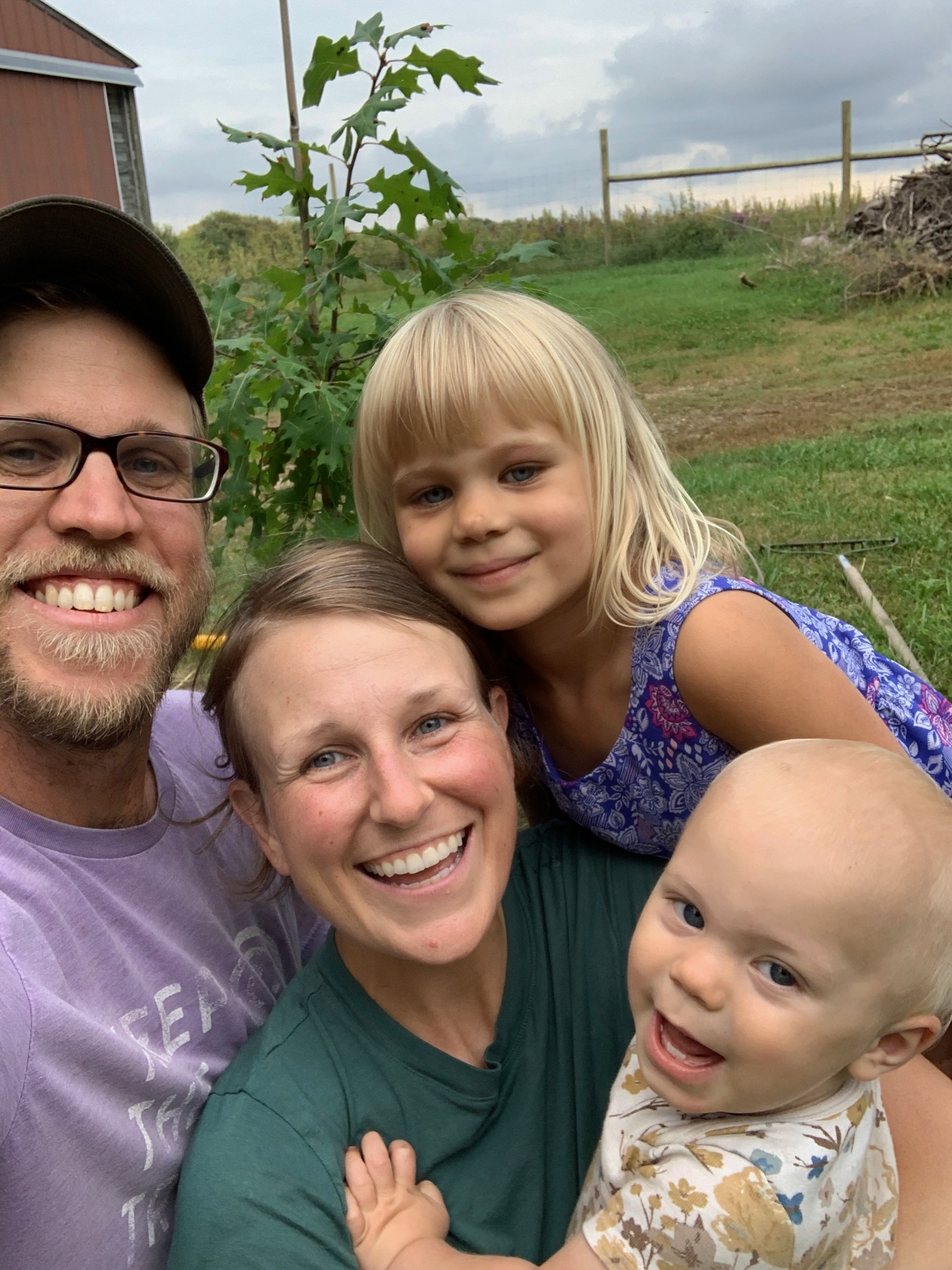
But the thread that runs through every chapter of the farm’s story is Karin’s commitment to rebuilding native habitat – not as a side project, but as something woven into the fabric of the operation itself.
Building Habitat from Scratch
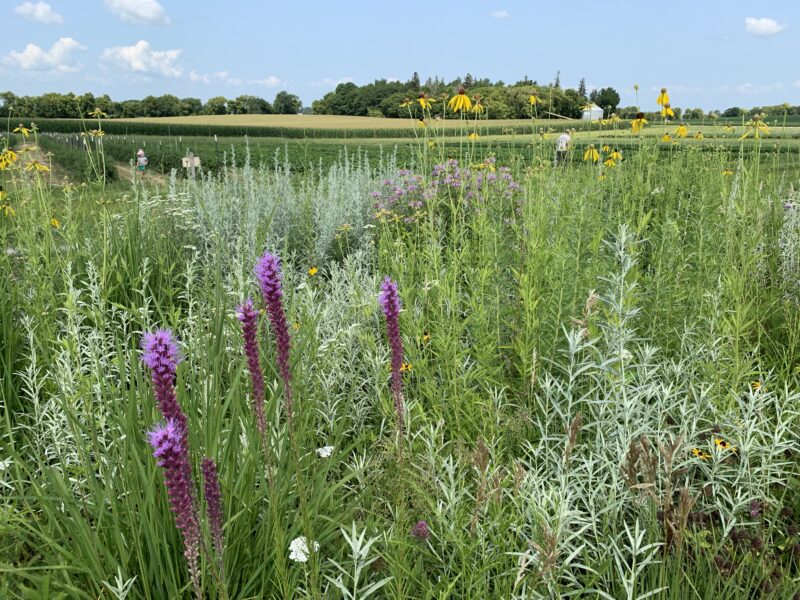
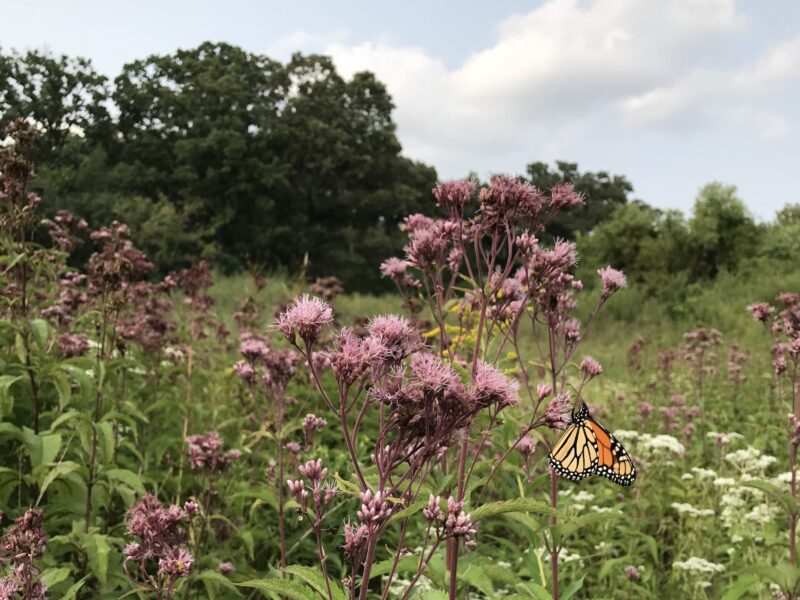
In the early years of the farm, Karin began tucking native plantings into corners and margins of the vegetable fields. She had plant materials from the farm’s greenhouse and a trained eye from her off-farm work helping farmers integrate pollinator habitat into agricultural landscapes. What started as single beds of native grasses and forbs grew into flowering hedgerows, diverse woody plantings dominated by aronia berry and elderberry, and eventually larger blocks of diverse prairie habitat.
“I was just constantly taking little corners to tinker with and put in plants and learn about that process,” Karin says, “and how they did or did not synergize with crop production.”
One of the more recent plantings, a quarter-acre demonstration garden near the homestead, contains over 50 species and was installed using 3,000 plugs grown on-farm. The common wisdom for prairie plantings is that the first year it sleeps, the second year it creeps, and the third year it leaps – but with plugs, Karin has found that leap comes much sooner.
Her approach to seeding has also evolved. Where conventional practice often treats habitat seeding as a one-time event, Karin advocates for repeated introductions of seed coupled with management activities like burning or grazing. “I’ve been coming to terms with just, like, almost every time we burn, I’m trying to find some missing species that should be interseeded to enhance diversity,” she says.
Restoring Oak Savanna
Behind the farm’s cultivated acres lies a stretch of land the family calls the Back Pasture – roughly 48 acres held in collective ownership by four siblings, who refer to it as the Nature Preserve. Historical aerial photos from 1938 show open, rolling hillsides with sparse trees. Today, the area is heavily wooded and choked with buckthorn, a common challenge across the Upper Midwest.
Karin suspected the site was formerly oak savanna based on the presence of open-grown oaks and some indicator wildflowers in the understory, and she has spent years working to tip the balance back. The strategy is layered: mechanical removal of invasive brush and some weedy canopy trees, targeted herbicide application on individual buckthorn stems, prescribed burns, interseeding with native grasses and forbs, and (since 2021) goats.
The goats arrived as ten small babies, purchased from a friend who ran a grazing business. “She’s like, no, don’t rent goats for buckthorn control – you guys are farmers. Just have goats!” Karin recalls. At first, the goats were too small to make a dent, and the family spent time cutting buckthorn down for them to eat in piles. But the relationship built trust and a taste for buckthorn.
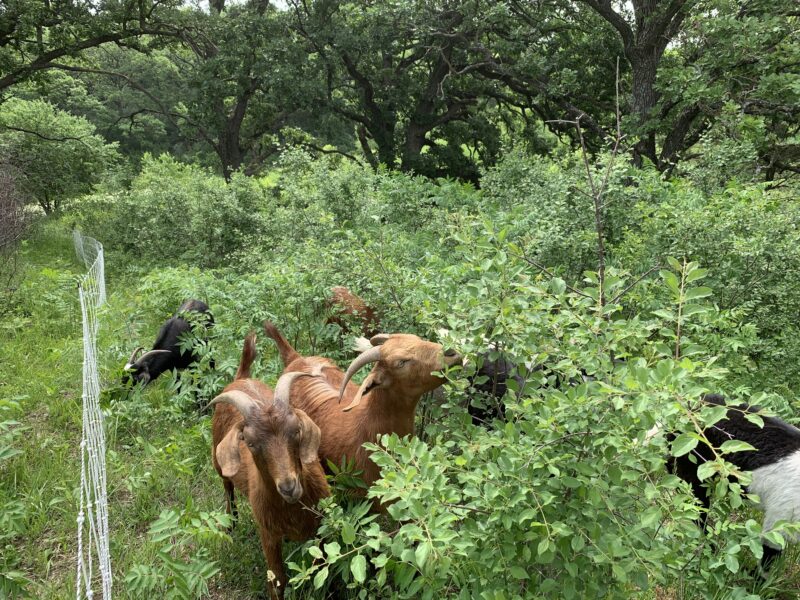
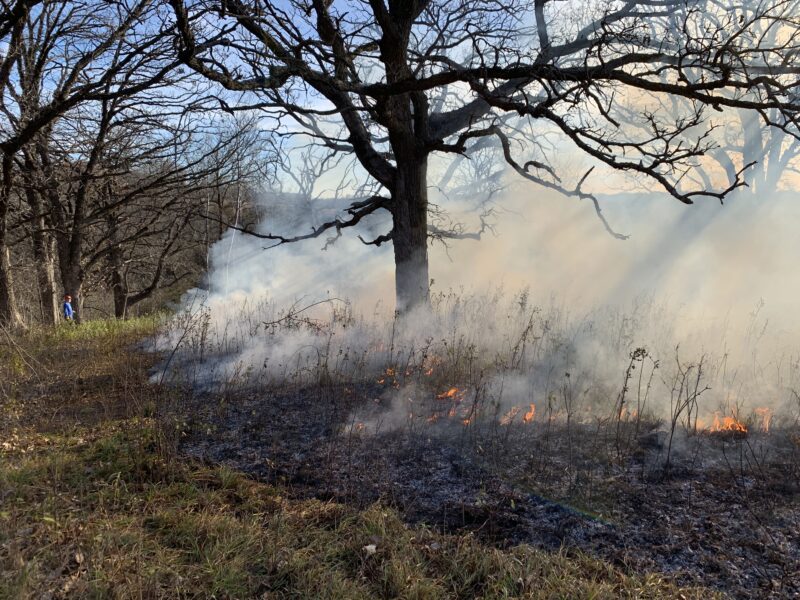
“I will maintain this over and over again, goats by themselves are unlikely to fix a buckthorn problem,” Karin says, “but they have helped us gain access to valuable spaces for restoration that we never would have prioritized in the past. Their grazing temporarily clears spaces, which allows us to see what our next steps should be in the restoration process.”
The goats now wear virtual-fence collars, eliminating the need for physical fencing. After each move to a new grazing area, Karin follows behind with spot herbicide treatments on re-sprouting stems, then interseeds and burns. The process is cyclical and ongoing – less a project with an end date than a relationship with the land that deepens over time.
Buffer Strips with Purpose
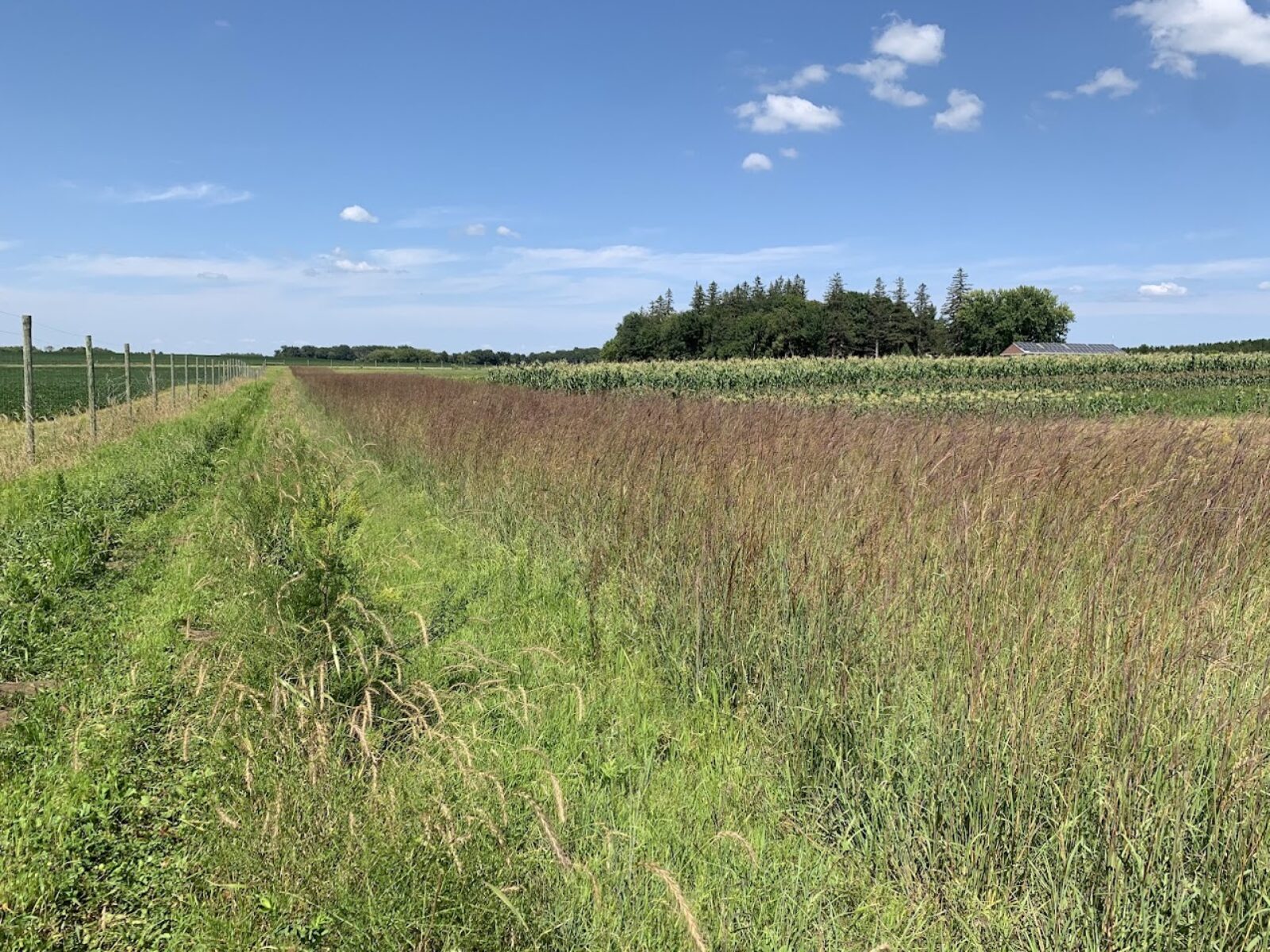
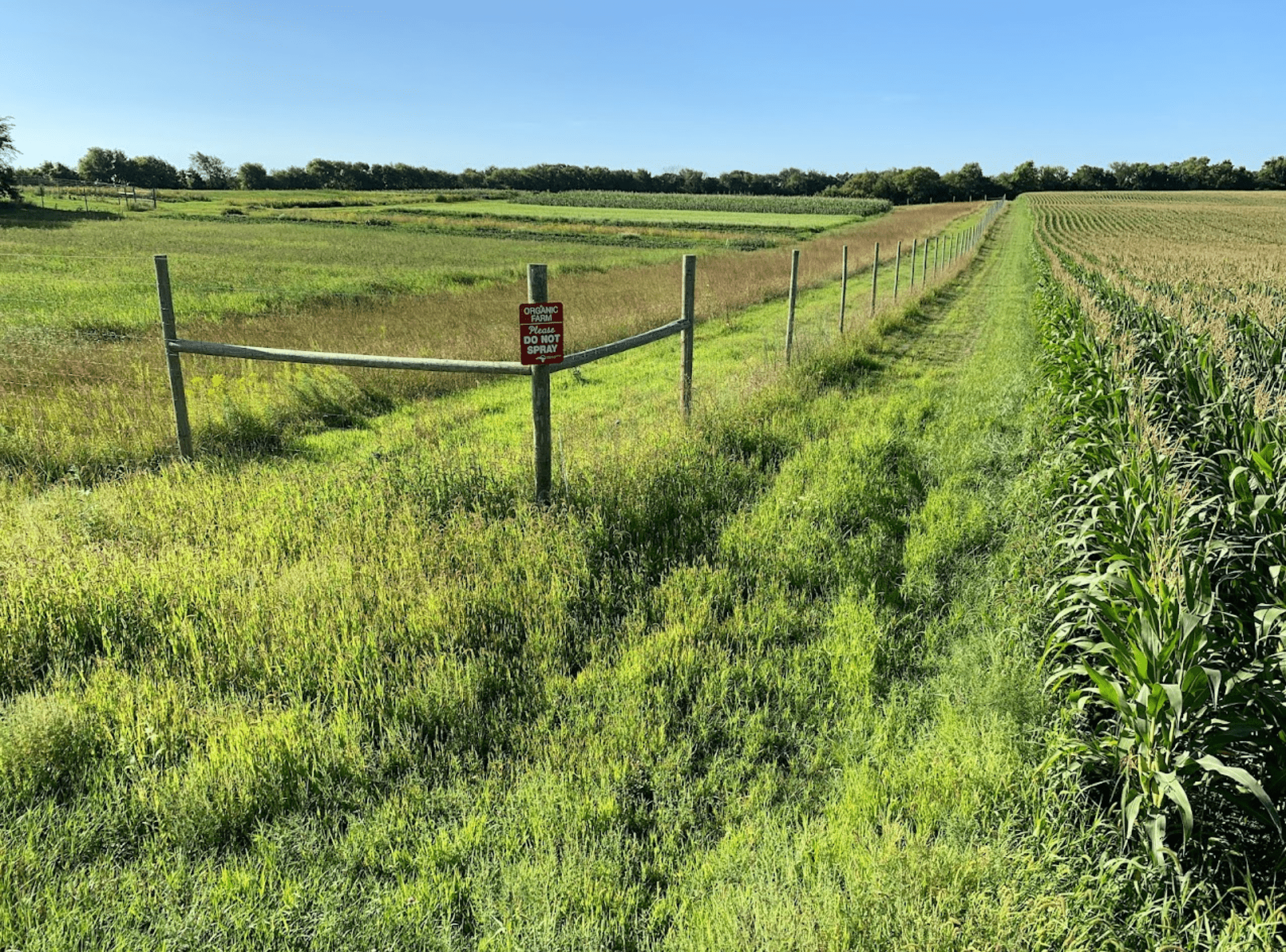
One detail from the farm’s layout illustrates how carefully Karin thinks about the relationship between agriculture and ecology. The buffer separating the organic farm from a neighboring conventional operation is engineered in layers: immediately adjacent to the conventional corn crop is a vegetated field road, then a row of young conifers planted ten feet inside the deer fence, then a 25-foot-wide native tall grass strip – no flowers at all. In total, there’s a 50-foot buffer between organic and conventional crops.
The reasoning behind the flower-free zone is deliberate. “Organic farmers often feel like, well, I have to take this land out of production to create a buffer anyway. Maybe that’s a great spot for my habitat,” Karin explains. “And what I’m trying to say is that’s not an ideal spot for habitat, because it’s the most likely place on the farm to be contaminated.” Flowering plants in a drift zone could attract pollinators into contact with pesticides. Instead, Karin places her pollinator habitat in more protected interior areas of the farm.
Looking Ahead
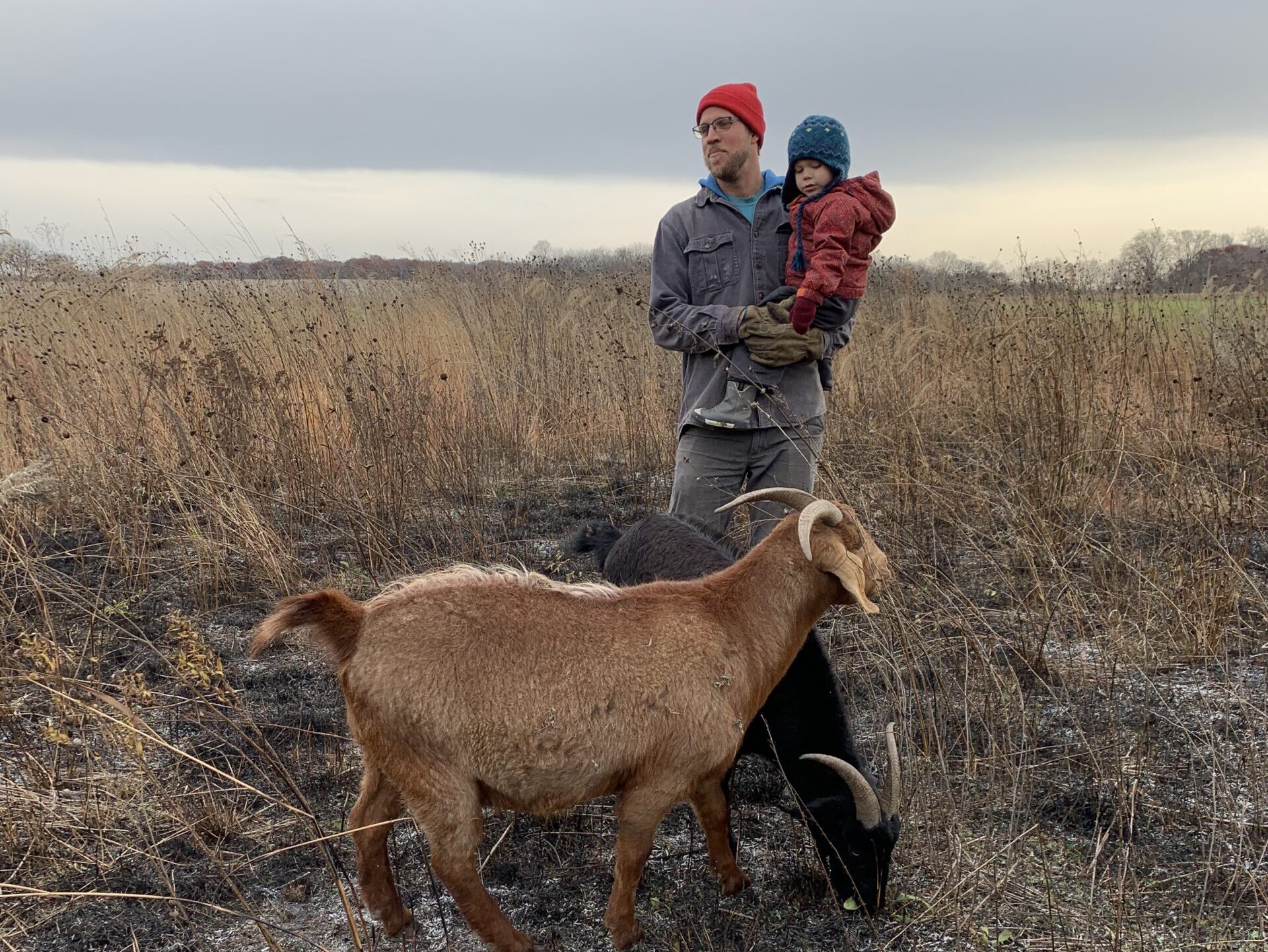
The Jokela family’s land stewardship has always been a collective effort. Siblings who share ownership of the Back Pasture come down for periodic work parties – cutting buckthorn, helping with burns, joining in spirit even when the pace of work can’t keep up with the scale of what needs doing. Friends join for native seed harvests and days spent gathering native foods from the land. The stewardship events aren’t just labor, but part of what makes the work sustainable and meaningful.
Karin is now channeling that spirit of shared work into something larger: a Prescribed Burn Association in Goodhue and Rice Counties. An interest meeting in late January drew roughly 45 people, and the list of interested landowners continues to grow to nearly 100 members. The association would create a network where landowners and non-landowners alike can participate in prescribed burns together – sharing equipment, knowledge, and labor across property lines.
“It has to be collective and more expansive,” Karin says of the restoration work ahead. The farm’s evolution – from diversified vegetable operation to perennial crops, from lone habitat plantings to community-scale burn networks – reflects a deepening understanding that land stewardship is not solitary work.
For Karin, the motivation circles back to something simple: remembering what the land can offer in return for good stewardship practices. “It’s not just to have the most biodiverse space for the insects or wildlife,” she says. “It can be for our pleasure and our community health. It’s to remember the foods that have sustained people here for millennia.”
Interview and article by Charlie Zieke, communications consultant. All photos provided by Sogn Valley Farm.
Learn more and sign up for Sogn Valley Farm’s newsletter at sognvalleyfarm.com.