
Dr. Katie Ross is an independent writer and researcher, with a background in ecology, renewable energy, regenerative agriculture, transdisciplinary research, and transformative sustainability learning. Knowing how stories hold, transmit and transform paradigms, Katie is keen to share these stories of regeneration.
How Nature Cools – Dr. Katie Ross
Why did Climate Land Leaders host a Nature Cools Project?
Nature has developed brilliant ways of cooling our landscapes and balancing our climates in the face of the Sun’s powerful, relentless energy.
In recognition of this living perspective of climate, Climate Land Leaders hosted a second Nature Cools project this summer (read about our 2025 trial).
The purposes of this project are to share the story of how Nature balances energy and climate (hint: the movement of water through life is key), and to – together – do several soil and landscape observations that demonstrate the principles of how Nature Cools, as well as deepen the relationship between Climate Land Leaders and their soils.
Read on to learn more about what we did and why; and then check out what we observed in the following blog: Out on the landscapes.
Short on time? Listen to this Public News Service piece about the project! ‘
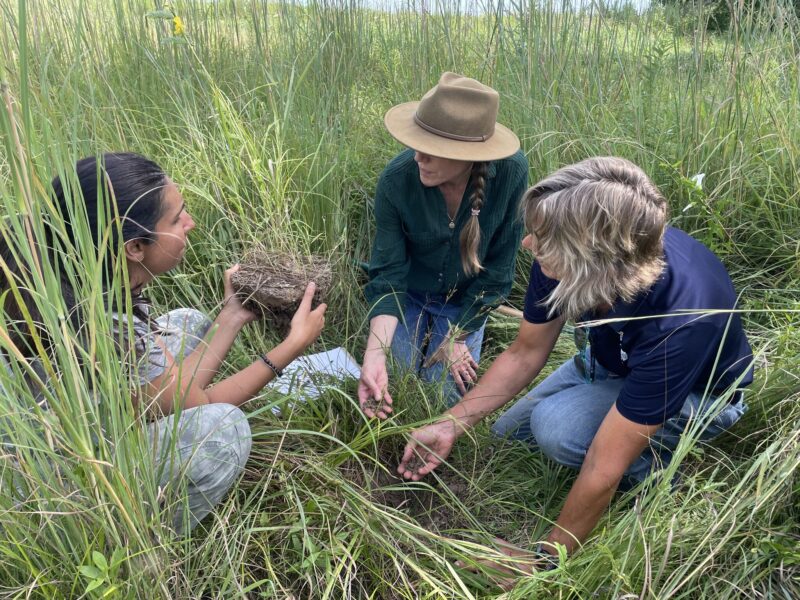
Before we begin, let’s set the scene.
Imagine. It is a sweltering, 100 degree day. There is not a cloud in sight, and the Sun is beating down.
You are sitting in your car waiting to pick up a passenger, and you can’t leave your vehicle.
On this blistering summer day, would you rather: have all the windows down with gentle breezes blowing through, shade screens on the windows reflecting the Sun away, all while sitting on a moist towel in your car? Comfortable, calm, and cool.
Or, would you rather: be sitting in a car with all the windows rolled up, on scorching black seats, and no shade screens covering your windows? Full Sun streaming. Sweat running in rivulets as the stifling heat grows exponentially.
– – –
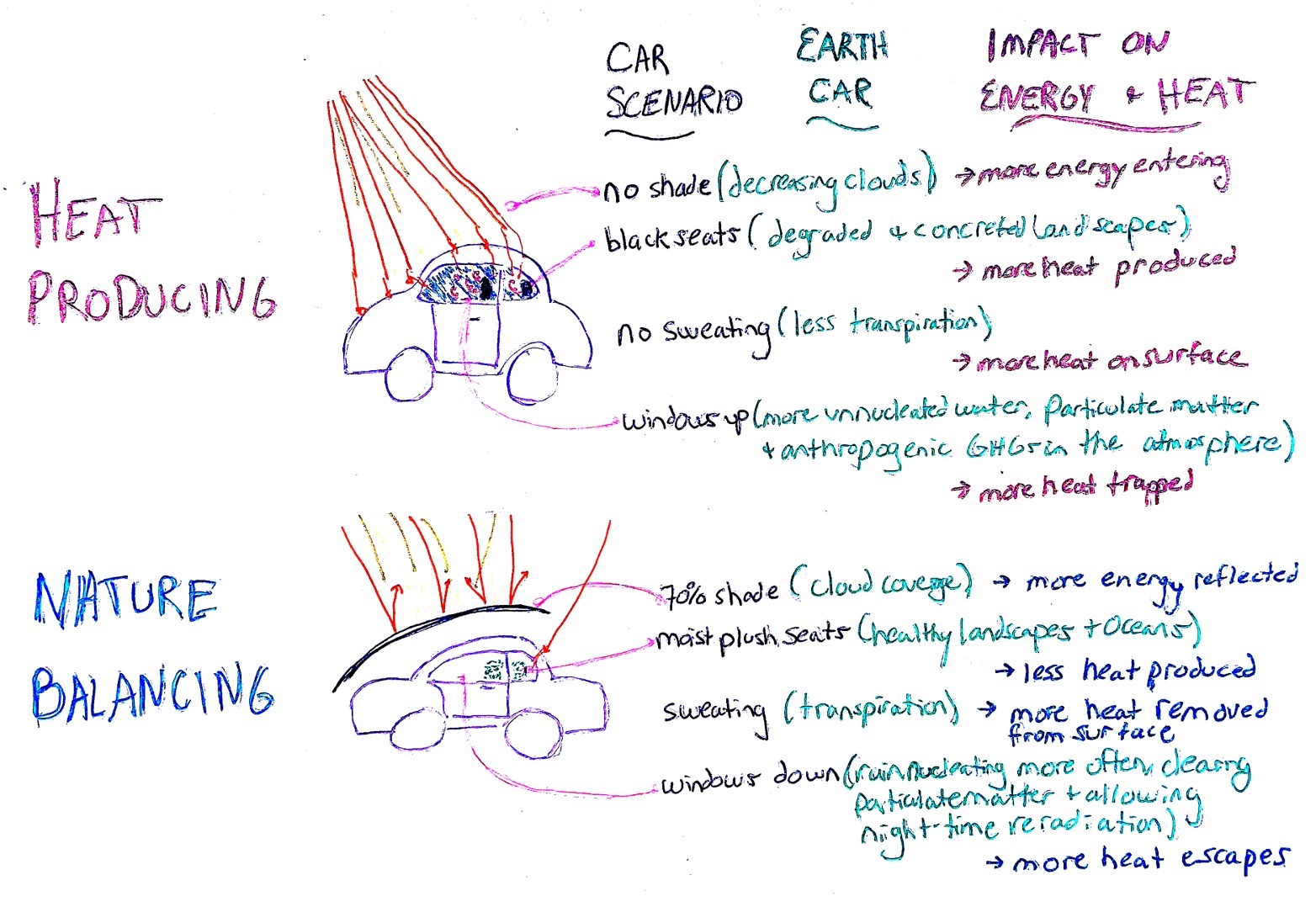
While the above is an overly-simplified metaphor, it attempts to illustrate how our living, interconnected Earth can keep our atmosphere and climate balanced – or not – through an experience we have probably all felt: the incredible heat-producing ability of a car parked in full sun.
What are the connections? Read on.
How Nature Cools
Let’s place this conversation in the broadest context possible: having a balanced climate means having the same level of solar energy leaving, as entering, our atmosphere – or Earth car.
Because we’ve transformed our landscapes, waterways, and atmosphere, we are now allowing more solar energy in, creating more heat on the Earth’s surface, and trapping more heat than we are releasing back out of our atmosphere. (Think: hot car, full sun, black seats, windows up).
The term to describe this situation – that more energy is entering our Earth system (and turning into heat) than leaving – is radiative forcing. And, there is growing recognition that radiative forcing is an equally important, if not more important, indicator to climate stability than emissions alone.
If this is the case, how did Nature balance our energy budget previously, before we inadvertently damaged so much? Looking at an Earth Energy Budget diagram gives us helpful clues:
Firstly, to balance our Earth’s energy budget, about 30% of the Sun’s energy should be reflected away from our atmosphere – by thick low clouds and white areas, like icy polar regions.
In our hot car metaphor, clouds are akin to putting up a giant sun reflector in the windshield in most of the windows of our Earth car. We immediately feel a difference in temperature by reflecting the Sun’s energy back out.
Our Earth, on average at any given time, should be mostly (70%) covered in clouds.
Spoiler alert though: our cloud coverage on Earth is decreasing because our microbial communities in our soils, plants and oceans are decreasing, and so our Earth’s reflector shield is decreasing. (What? Yes. More on these relationships below.)
Secondly, to balance our Earth’s energy budget, roughly a quarter of the Sun’s energy should be transported back away from the earth’s surface by the transpiration of water from diverse, green ecosystems, i.e. plants.
When this rising water vapor condenses into low, thick clouds, the ‘latent heat’ (or energy released from vapor as it condenses back into water) has a greater chance of escaping out of the atmosphere.
Plant transpiration is like us sweating in the hot car to cool ourselves as the water evaporates off our body. Like the spoiler alert above though: our challenge on Earth is twofold. Not only have we significantly reduced grasslands, forests and other green, living landscapes that transpire to remove the heat, but also in doing so, we have significantly reduced the volume of biological rain-nucleators that allow water vapor to condense and release that latent heat. (Again, I’m foreshadowing the below!)
Thirdly, to balance our Earth’s energy budget, after a cool rain has washed the skies clean of particulate matter, roughly another quarter of the Sun’s energy should be re-released from the ground during clear ‘night-time re-radiation windows’. This is akin to opening the windows of our Earth car allowing the heat to escape.
And for the final piece of this metaphor for why our Earth car is heating up, we’ve got to dig into a physics term: the Stefan-Boltzmann law. Basically, this law shows that when solar energy hits a surface, it re-radiates back in with an exponential level of heat, relative to the current temperature of the surface.
So, when green landscapes are photosynthesising, transpiring, and cooling, this is no big deal, as the sunlight hits relatively cooler surfaces. But surface areas like bare soils, concrete, and degraded landscapes are producing ever increasing levels of exponential heat, compared to living landscapes.
So back to our hot car scenario: originally, 100% of the inside of our Earth car was covered in a deliciously cooling moist mossy towel. But now, 75% of our Earth’s surface has been dramatically altered (drained, covered, bare soil, etc) and the re-radiating heat in our Earth car is metastasizing.
However – and this is where things get exciting and hopeful – land stewardship can address all of this.
Life moving water balances our Earth’s energy budget
There are several fascinating ways that Nature Cools.
Firstly, as foreshadowed above, diverse plants and green living landscapes transpire as they eat the sunlight. (Okay, technically, scientists argue plants and phytoplankton do not ‘eat’ the Sun, but if this metaphor is good enough for Zoë Schlanger, it’s good enough for me!)
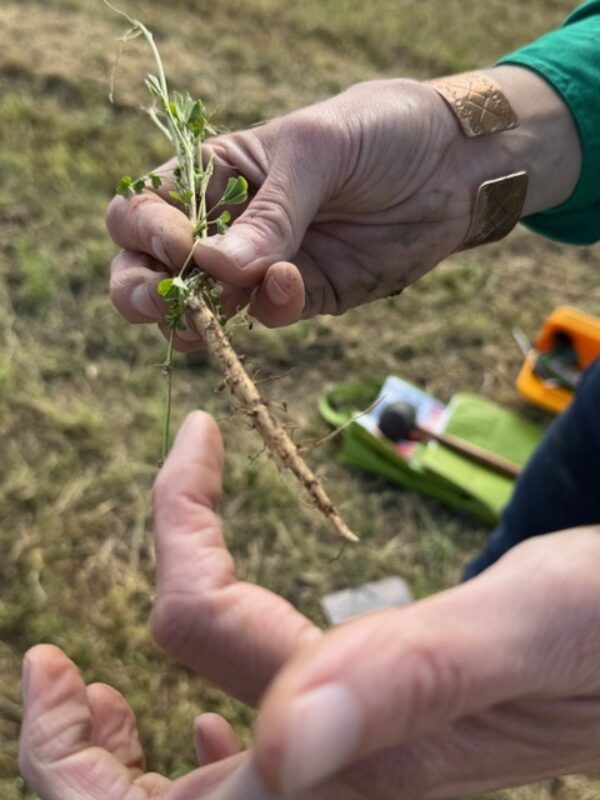
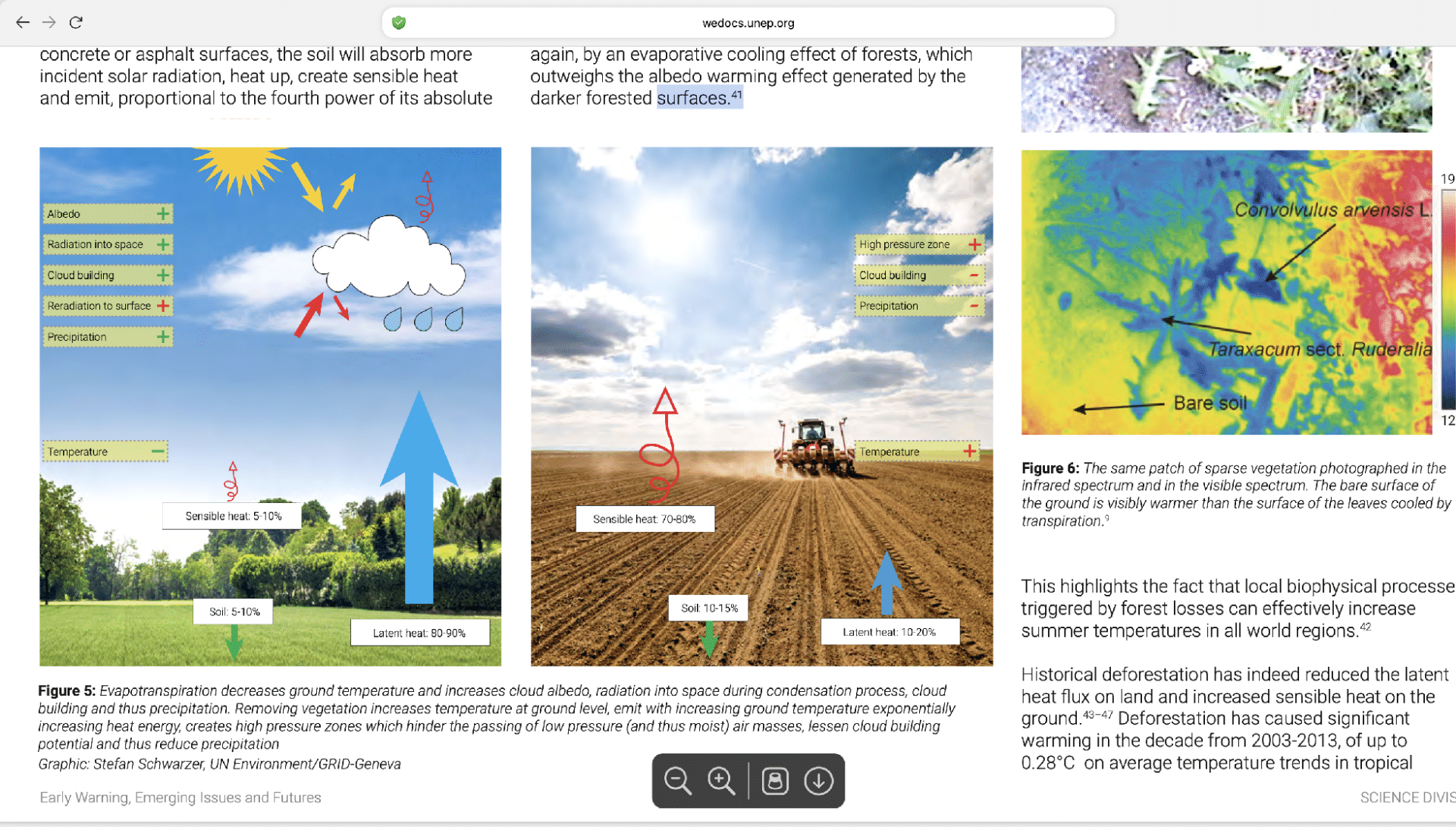
When diverse plants transpire while they eat the sun, they effectively create heat elevators. They take the sun’s energy that could be turned into heat we feel (e.g. sensible heat), and instead use this energy to turn water into water vapor (e.g. latent heat), which rises up into the sky, transporting the Sun’s energy away from the earth’s surface.
And essential to this story is that fungi in healthy soils, bacteria in healthy landscapes, and phytoplankton in oceans and living waters, all add their bits of life which hitch a ride into the atmosphere with water vapor and wind currents.
These microscopic bits have a crucial, essential, irreplaceable job. They are what’s called ‘cloud condensation nuclei’, or ‘biological ice nucleators, or ‘bio-nucleators’.
They help water vapor condense into thick, sun-reflecting clouds, at ‘very warm’ temperatures – i.e. lower levels in the atmosphere. This also means that rain forms and falls closer to where it transpired.
And, as mentioned above, when the water vapor condenses into clouds, this released ‘latent heat’ has a greater chance of escaping out of the atmosphere.
– – –
So, when Climate Land Leaders steward landscapes towards more life above and below ground, their regeneration efforts cool our climate, and help balance our energy budget in several important ways:
- Fungi-fuelled soils, plant transpiration, and phytoplankton in waterscapes foster bio-precipitation, which means local, cooling rain more often. And, these healthy landscapes effectively capture and store this rain in the soil (like keeping our seats moist and mossy on our Earth car).
- Rain-cleared night-time reradiation windows allow trapped heat to more freely escape out of our atmosphere (like opening our Earth car windows).
- Diverse plants transpire heat from the Earth’s surface (like us perspiring in our Earth car).
- Plants shade everybody, from soil organisms to mammals to songbirds. And, bacteria on plants, and fungi in soils increase the frequency of thick, sun-reflecting clouds (like putting up solar reflectors in our Earth car).
- Restoring any degraded, heat-generating, landscapes and waterways to places that cool via the above processes (changing our Earth seats from black leather to moist, mossy surfaces).
As often repeated by Walter Jehne, hydrology governs 95% of the Earth’s heat dynamics, and three processes are most significant: transpiration, clouds reflection and nightly re-radiation windows. By supporting diverse life below and above ground, we can help regenerate these governing processes.
So, what happened during the Nature Cools project?
There are many observations to contextualise how land stewardship helps Nature Cool. We could observe many dimensions and relationships of water and energy flows, plants, soils, microbes, animals and waterscapes.
Amidst this complexity, we prioritized two observations to illustrate how land stewardship helps #NatureCool: water infiltration and temperature.
With four participating Climate Land Leaders in Illinois and Wisconsin – across sites with differing histories and stewardship approaches – we asked:
- How long will it take for one inch of water to infiltrate into the soil in dry and wet conditions? (USDA, 2008; Soilmentor, 2026), and
- What are the temperature differences of: air at shoulder height, soil surface, and soil subsurface on a hot summer day?
Why water infiltration?
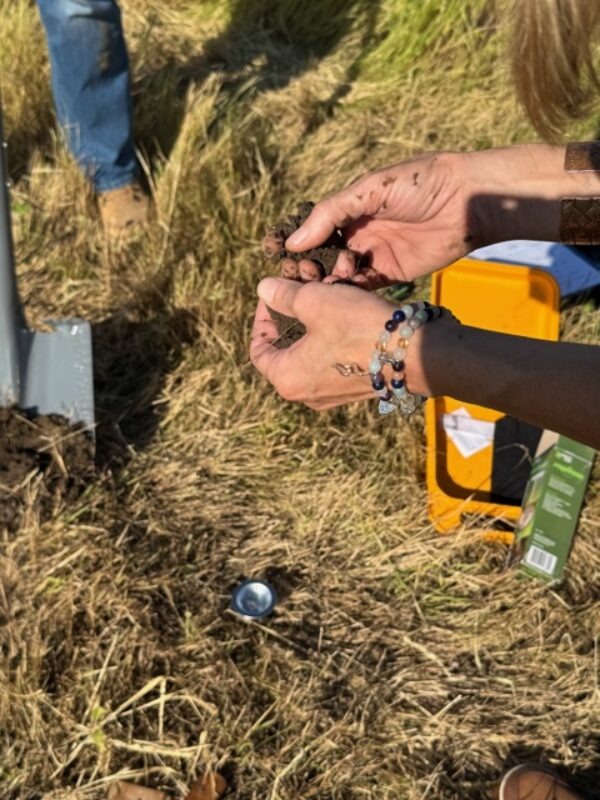
As our first soil observation, timed water infiltration illustrates the ability of soil to absorb and effectively capture rainwater.
As the saying goes, it’s not the volume of rain, but the landscapes’ ability to harvest and store each drop in order to better:
- support diverse soil organisms, such as rain-nucleating fungi and bacteria;
- help plant life into drought longer, and out of drought faster;
- ensure plants are cooling through transpiration and transporting cloud nucleating bacteria.
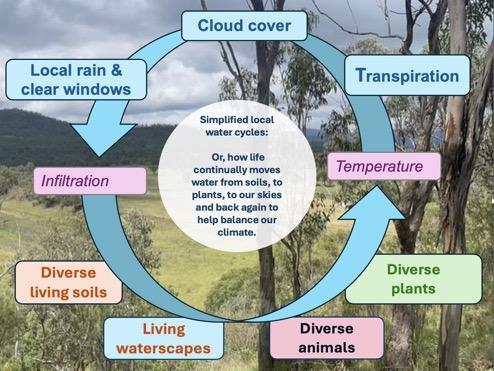
In other words, holding water in the soil is fundamental for plant health, climate balancing and precipitation (Figure 2).
A fast infiltration can indicate stable soil aggregates and structure, around which water can percolate down. (In some cases, fast infiltration might indicate sandy soils and the need to build organic matter.)
A slow infiltration rate can indicate compacted or poor soil structure, with unstable aggregates blocking water from percolating downwards. Instead water runs off, taking topsoil and nutrients with it.
How to do a water infiltration
A simple water infiltration observation involves a 6-inch diameter tube (either PVC, metal drain, or even an old Folger’s coffee tin), 900 mL of water, perhaps a rubber mallet (depending on your soil type) and a timer.
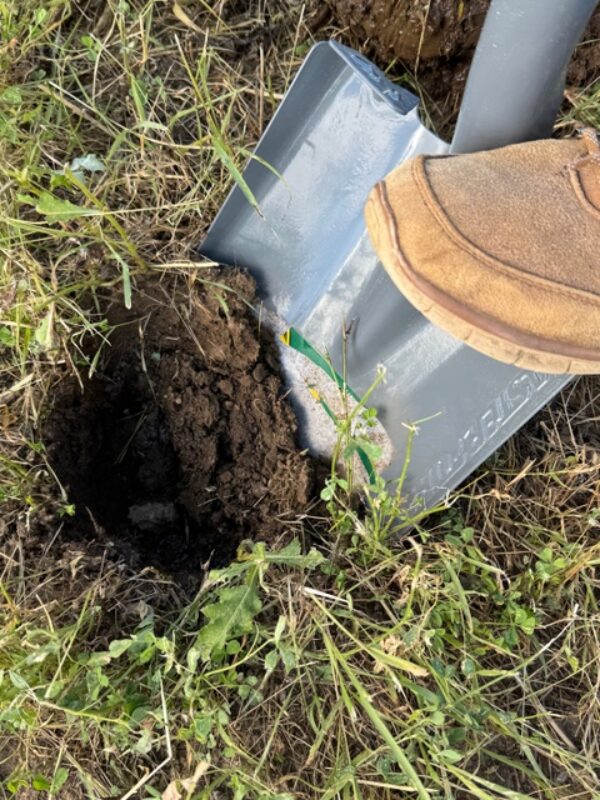
Pick a site representative of the pasture, push or mallet the tube 3 inches down (being careful to push the tube evenly across its diameter), and pour in one inch of water (which equates to around 450ml of water).
Record the time it takes for the first pour to disappear into the soils, and then time it takes for a second pour to infiltrate, and compare how the soil absorbs water when both dry and when more saturated.
If time permits, you can also observe water infiltration in three to four different places in the same pasture, to account for diversity in soils and soil life occurring even in the same paddock.
Soilmentor and the USDA provide helpful guidance on making your tube, and the methodology.
Why temperature?
Our second soil observation was temperature of air, ground surface and below ground across diverse landscapes and management practices.
Diverse living landscapes produce more latent heat (e.g. energy stored in rising water vapor), while dry, microbial-poor dirt produces more sensible heat (e.g. heat we can feel) (Figure 3).
So, measuring temperature can illustrate the difference in sensible heat, depending on how easily the landscape absorbs energy and whether the Sun’s energy is being reflected, shaded or removed as latent heat (Figure 2).
In other words, is the landscape cooling or heat-generating (Figure 3)?
Measuring soil surface and subsurface temperatures also helps with observing soil health. Between 65°F and 85°F, beneficial bacteria and fungi thrive, accelerating organic matter breakdown and nutrient cycling, but this is only achieved if adequate moisture is available.
And importantly, wet soil takes more energy to heat up due to the high specific heat capacity of water, acting as a temperature buffer that protects microbes from extreme fluctuations.
Conversely, high temperatures increase evaporation rates, which can rapidly deplete moisture needed for growth, temperature moderation, and microbial activity.
With dry conditions, microbial respiration drops dramatically regardless of temperature. And if temperatures exceed 110°F to 115°F, some crucial soil microbes begin to die off, crippling the soil’s natural fertility.
How to compare temperatures
To compare temperatures, we used:
- a six-inch soil thermometer (which at times needed a pilot hole made with a screwdriver). We took readings in both shaded and unshaded areas, if these were in close proximity.
- an infrared gun for the soil surface. To get an average across various surface qualities of the site, we took 5 – 7 readings around the chosen location.
- an instant digital thermometer for air temps. If it was a partially cloudy day, we did multiple readings to note temperature differences in Sun and cloud coverage, to help see how quickly temperature can change with cloud coverage.
– – –
Figure 2 summarizes how these two observations – temperature and water infiltration – relate to Nature’s cooling processes. The caveat is that water infiltration and temperature can change relatively quickly, depending on many factors, so these observations are done in the spirit of ‘pragmatic science’ which prefers practicality and getting to know your soil, over precision.
To acknowledge the living complexity underlying Nature’s cooling, we also channelled our inner 5 years olds, and dug about in the soil, looking and smelling for signs of life, including the delicate, thin, spidery, white, filamentous trails of mycorrhizal fungi – whose importance cannot be overstated (have a listen to this Soils for Life Podcast on The network underpinning it all: Fungi with Dr Sapphire McMullan-Fisher and Julie Fielder).
If you are keen to do a greater range of soil observations, here are two helpful soil monitoring guides:
- Soilmentor by VidaCycle and Nicole Masters
- Measuring and Monitoring Soil Health by Soils for Life
Want to delve deeper into Nature Cools?
Nature’s entire cooling dynamics are beautifully complex – and science is continually emerging. (Did you hear how bacteria in the bark of trees that ‘eat’ climate gases were just recognised this year?!).
Here are some helpful initial resources on this living system perspective of climate:
- Stephan Schwarzer, 2021. Working with plants, soils and water to cool the climate and rehydrate Earth’s landscapes. UNEP.
- Rob Lewis, 2023. Millan Millan and the Mystery of the Missing Mediterranean Storms: A Scientific Odyssey in Three Parts.
- Walter Jehne, 2018. The Soil Carbon Sponge, Climate Solutions and Healthy Water Cycles
- Erica Gies, 2025. Climate science and the case of the missing moisture. Nature, or her TedX talk.
- Mallory Barnes, and others, 2024. A century of reforestation reduced anthropogenic warming in the Eastern United States, Earth’s Future, 12.
- David Ellison, and others, 2017. Trees, forests and water: Cool insights for a hot world. Global Environmental Change, and his 2023 follow-up: Even cooler insights: on the power of forests to (water the Earth and) cool the planet.
- Douglas Sheil. 2018. Forests, atmospheric water and an uncertain future: the new biology of the global water cycle. Forest Ecosystems.
- And, a link to many more presentations, scientists, short videos, documentaries, books, and organisations.
Curious what we found while on the farm? Read our second blog here.